Youdha ePod G Cargo Three-Wheeler: Specs Are Only Half the Case

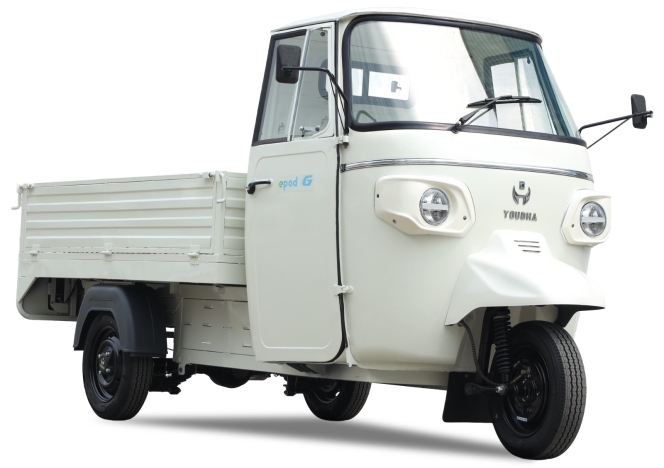
Youdha has launched the ePod G, an electric cargo three-wheeler that takes its passenger platform into goods transport. The company’s claims are clear on paper, but sources disagree on payload, range and price, and those are the figures fleet buyers will compare first.
Youdha, the electric commercial mobility brand of Zuperia Auto, has launched the ePod G, extending its ePod range beyond passenger use into cargo. The company’s launch post describes an 11.8 kWh lithium iron phosphate battery, a 6 kW motor, a payload of 545 kg, a gross vehicle weight of 1,000 kg and charging in four to five hours. It claims a range of 170 to 180 km under standard test conditions. The move puts Youdha into the cargo segment, where operating economics, rather than specifications, decide most purchases. The information available to us does not yet allow an independent verdict on those economics.
The timing is relevant. Autocar Professional reported on 9 October 2026 that Youdha had manufactured its 1,000th ePod, a milestone the company says will support wider product, dealer and southern expansion. That figure measures production, not sales. Registrations recorded in VAHAN would show how many vehicles have reached customers, and we have not accessed that data for this article. The cargo variant will be judged on the same conversion from factory output to working vehicles on the road.
The Specifications Disagree Across Sources
Youdha’s figures do not match across sources, which matters for any buyer comparing payloads. The company’s post gives a 545 kg payload. A TrucksBuses listing for the ePod G gives 1,200 kg, with 170 cubic feet of cargo volume and a 130 km range. A 91Trucks review of the ePod cargo variant gives a maximum payload of 725 kg and an estimated ex-showroom price of ₹2.50 to ₹2.70 lakh, although that price is the reviewer’s estimate rather than an official figure. A difference between 545 kg and 1,200 kg is not a rounding error. It changes the loads a vehicle can carry and, in practice, the routes it can serve. We have not reconciled these figures. Payload and gross vehicle weight should be checked against Youdha’s homologated specification before publication.
Range is also conditional. The company claims 170 to 180 km under standard test conditions. The passenger ePod carries a certified range of 227 km, according to EV Reporter and Autocar Professional. Real-world range under full payload, in city traffic and in high ambient temperatures typically falls below certified figures, and the test cycle behind each claim is not stated in the sources we reviewed. Charging time is more useful for fleet planning. A four-to-five-hour charge determines how many shifts a single charger can support, and therefore how much of the day a vehicle can work.
Competitive Pressure and the Missing Price
Youdha already sells a cargo model. The Trevo L5, according to Autocar Professional’s report on its launch, is priced at ₹4.35 to ₹4.75 lakh ex-showroom and is aimed at logistics operators moving from internal-combustion cargo vehicles. The same report names Mahindra Zor Grand, Euler Motors HiLoad EV, OSM Rage Plus, RapidEv Pro and Altigreen neEV as rivals. The sources we reviewed do not publish a price for the ePod G. Without one, a fleet manager cannot compare payload per rupee or running cost per kilometre, which is the calculation that decides most cargo-vehicle purchases.
Our analysis is that the ePod G’s pricing will determine how it sits against the Trevo. If the ePod G is priced at or near the Trevo, Youdha would be competing with itself for the same buyer. If it is priced below, the company would need to show that a lower purchase price does not come at the cost of payload or durability. The company has set a target of ₹1,000 crore of revenue by 2030, as Autocar Professional reported when the passenger ePod launched, which implies that it expects strong volume growth in both segments.
Why a Passenger Platform Carries Cargo Risk
The ePod began as a passenger vehicle. The passenger model is certified in the L5 category at ₹2.79 lakh, with a monocoque chassis, an 11.8 kWh battery and a 6 kW motor, and it is built at Youdha’s Kashipur plant, which has an annual capacity of 100,000 units, according to Autocar Professional. Building a cargo version on a shared platform has clear advantages. Battery, motor and controller costs can be spread across two products, and existing production lines can be used.
Shared platforms also carry risks. Cargo bodies, higher gross weights, altered suspension and braking, and tyre loading all need validation. The sources we reviewed do not say whether the ePod G shares the passenger chassis or needs new engineering, nor whether its braking and suspension were revised for a 545 kg or higher payload. Those are the questions an operator should ask before relying on the vehicle for daily deliveries.
Operators should also ask what the vehicle will cost to run. Energy use per kilometre, battery replacement intervals, maintenance schedules, tyre wear and days lost to service are the inputs that determine total cost of ownership. The sources we reviewed give none of these figures for the ePod G. Financing terms are similarly unclear, and at least one listing states that loan EMIs are not available for the model. For a small fleet owner, service response times and the availability of spare parts in the local market may matter as much as the battery specification.
The question for the industry is whether Youdha can show a verified payload, a published price and a per-kilometre running cost before the ePod G reaches showrooms in volume. The 1,000-unit milestone shows that production is moving. Registrations, independently checked payload figures and disclosed running costs will show whether the cargo variant is a practical product for delivery fleets or another model competing for the same loading-auto buyer.