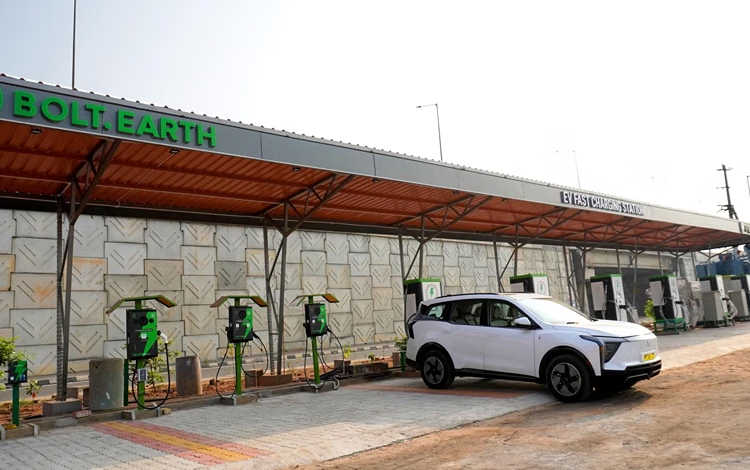
Bolt.Earth has commissioned a 1.5 MW electric vehicle (EV) charging station at P Qube Solutions in Vijayawada, Andhra Pradesh. Located near NH-16 Cross in Nunna, the facility is designed to serve both local EV users and vehicles travelling along the highway corridor.
The deployment brings charging options for multiple vehicle categories under one roof, including electric two-wheelers, three-wheelers, passenger cars, trucks and buses. Its location is intended to address a requirement that is becoming increasingly important as electric mobility expands beyond city-based commuting: access to charging infrastructure on intercity routes.
Charging infrastructure for multiple vehicle categories
The facility includes a mix of high-power DC fast chargers and lower-power charging options for smaller electric vehicles. For cars and heavier commercial vehicles, the installation has two 240 kW DC fast chargers, three 180 kW DC fast chargers and one 60 kW DC fast charger.
Smaller EVs are also catered for. The station has one 6 kW fast charger for three-wheelers, two 3 kW DC fast chargers for two-wheelers and four 3.3 kW AC charging sockets.
Charging infrastructure at P Qube Solutions
High-power DC chargers: 2 × 240 kW, 3 × 180 kW and 1 × 60 kW
Three-wheeler charging: 1 × 6 kW fast charger
Two-wheeler charging: 2 × 3 kW DC fast chargers
AC charging: 4 × 3.3 kW sockets
Location: P Qube Solutions, near NH-16 Cross, Nunna, Vijayawada
The mix is notable because charging requirements vary considerably across vehicle segments. A passenger car, an electric bus and a delivery two-wheeler do not have the same battery capacity, charging needs or operating schedules. A facility that accommodates these different users could serve a broader pool of customers than a station designed around passenger cars alone.
Why the NH-16 location matters
For highway charging, location is as important as the power rating of the chargers. A high-capacity station has limited value to intercity operators if it is difficult to access, poorly positioned along a route or unable to support vehicles when they need to recharge.
By placing the facility near NH-16, Bolt.Earth is positioning it to serve two distinct demand pools. The first is local demand from EV owners and commercial operators in and around Vijayawada. The second is intercity traffic that may require charging while travelling along the highway corridor.
This distinction matters particularly for electric commercial vehicles. Trucks and buses typically operate against schedules, making charging time and the availability of suitable charging infrastructure important considerations. High-power chargers could help reduce the time vehicles spend waiting to recharge, although actual charging duration will depend on vehicle compatibility, battery capacity, charging limits and the power available at the site.
The presence of lower-power charging options also broadens the facility’s potential user base. Two-wheelers and three-wheelers often have different operating patterns and charging requirements from cars and commercial vehicles. Serving them at the same location could help improve the usefulness of the site across different times of the day.
Partnerships will be important to infrastructure expansion
Bolt.Earth Founder Jyotiranjan Harichandan said the project brings together charging capacity, high-power DC chargers and a strategically located site. He also highlighted partnerships with site operators as an important part of expanding charging infrastructure beyond established urban markets.
That approach points to a wider challenge in the charging business. Expanding a network is not only about installing chargers; it also requires access to suitable locations, reliable power connections, equipment, software and ongoing maintenance. Site partnerships can help charging companies enter new markets without having to independently develop every location.
D Phani Prakash of P Qube Solutions said the collaboration was selected to provide charging solutions for two-wheelers, three-wheelers and passenger cars. He also cited the availability of hardware, software and after-sales support as factors behind the partnership.
These elements will influence the experience of users after commissioning. Charger uptime, payment reliability, ease of locating the facility and the availability of technical support can determine whether a charging station becomes a regular stop or is used only when alternatives are unavailable.
Will capacity translate into utilisation?
The commissioning adds another high-capacity charging facility to Andhra Pradesh’s EV infrastructure. However, the longer-term significance of the project will depend on how effectively it is used.
A multi-vehicle charging station has the potential to serve several customer segments, but each brings a different utilisation pattern. Private cars may arrive intermittently, while commercial vehicles could offer more predictable demand if fleet operators incorporate the location into their routes. Two- and three-wheeler users may generate additional demand, but their charging requirements and willingness to use a highway-adjacent facility will differ.
There are also practical questions around the station’s power availability and simultaneous charging capability. The company describes the facility as a 1.5 MW station, but the combined rated output of the individual chargers listed in the announcement is approximately 1.105 MW. The relationship between the stated site capacity and the aggregate charger rating should be clarified, including whether the 1.5 MW figure refers to sanctioned electrical capacity or another measure of the installation.
For now, Bolt.Earth’s Vijayawada deployment represents an attempt to bring different forms of EV charging together at a location with highway access. Its performance will ultimately be measured not just by installed capacity, but by charger uptime, vehicle throughput, repeat usage and the ability to serve commercial vehicles without disrupting their operating schedules.
As highway electrification develops, the next question for charging providers is no longer simply how many chargers can be installed. It is whether those chargers are located where vehicles need them, compatible with the vehicles using them and utilised enough to sustain the network.