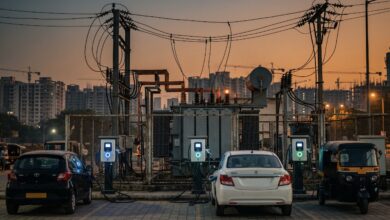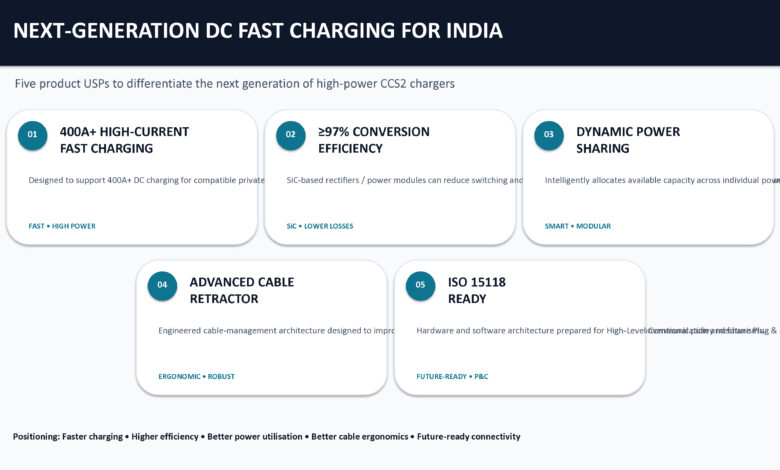
As India’s EV market matures, the future of DC fast charging will be defined by much more than higher charging speeds. From high-current charging and SiC-based efficiency to intelligent power sharing, improved cable ergonomics and ISO 15118 readiness, the next generation of chargers must deliver greater performance, reliability and user convenience. In this article, Sumit Kumar, AVP – Product, Statiq, explores five product innovations that could redefine India’s DC charging experience.
400A+ charging: reducing charging time without simply increasing charger size
High-current charging is becoming increasingly relevant as passenger EVs move toward higher-voltage architectures and larger battery packs. A DC charger capable of supporting 400A+ can deliver substantially more power when the vehicle, connector, cable and thermal-management system are designed for it. The important product-design principle is not merely a high nameplate current; it is sustained current delivery under Indian ambient conditions, with appropriate cable cooling, connector temperature monitoring and protection. This capability can help reduce charging dwell time at high-utilisation sites and improve the economics of premium fast-charging locations. India’s charging framework already accommodates Level 3 DC charging up to 400 kW and CCS2 is among the listed compatible interfaces, creating room for higher-power passenger-vehicle charging architectures. However, the charger should clearly state that 400A+ operation is subject to vehicle, connector, cable and site limitations.
Dynamic power sharing: use installed capacity where the vehicle actually needs it
A modular charger should not treat its power modules as isolated blocks. Dynamic power sharing allows available capacity to be allocated according to real-time vehicle demand. For example, if one vehicle is requesting high power while another is tapering near a high state of charge, the control system can redistribute module capacity to improve overall utilisation. This architecture can also improve redundancy and serviceability because the charger can be designed around modular power blocks rather than one monolithic conversion stage. The key differentiator is intelligent allocation: module availability, vehicle demand, thermal constraints and output limits should all be considered by the power-management algorithm.
Advanced cable retraction: the overlooked part of the charging experience
High-power DC cables are heavy, stiff and increasingly difficult to handle as current ratings rise. Conventional pulley-based cable retractors can add mechanical complexity and may not always provide an ideal user experience. An advanced cable-management mechanism should keep the connector accessible, minimise cable drag, maintain controlled bend radius, prevent cable contact with the ground and reduce mechanical stress on the connector and cable. For operators, better cable management can also reduce misuse and improve site appearance. For drivers, it can turn a physically demanding charging session into a simple plug-and-charge interaction.
ISO 15118 readiness: build the charger for the next generation of EV interaction
ISO 15118 defines communication between the EV and EV supply equipment and provides the foundation for advanced functions such as identification, charging control, optimisation, cybersecurity and, in relevant versions and implementations, bidirectional power transfer. The product requirement should therefore be broader than simply saying “ISO 15118 compatible”. A future-ready charger should have the required PLC/communication architecture, secure certificate handling, firmware capability and backend integration path needed to enable Plug & Charge when the vehicle, charging network and certification ecosystem support it. This is especially important because Plug & Charge is an ecosystem feature, not a feature that can be guaranteed by the charger alone.
Note to Readers: The views expressed in this article are those of the author and are presented for informational purposes only. They do not necessarily represent the views of Mobility Electrified.