Blue Energy Motors, HPCL Open Truck Battery-Swapping Station

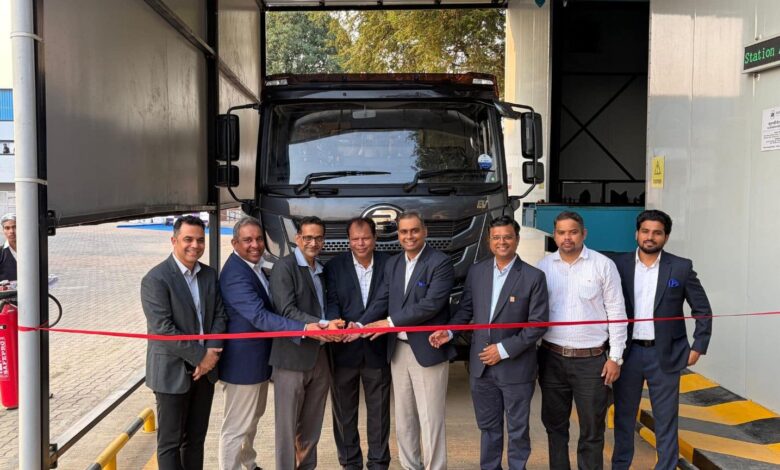
Blue Energy Motors and Hindustan Petroleum Corporation Limited (HPCL) have commissioned a battery-swapping station for electric heavy-duty trucks in Bhiwandi, Maharashtra. The facility enables battery replacement in under five minutes, according to the company, and extends the Mumbai–Pune Electric Freight Corridor. The larger question is whether this infrastructure model can make electric freight more practical at scale.
Blue Energy Motors (BEM) and Hindustan Petroleum Corporation Limited (HPCL) have operationalised a battery-swapping station for electric heavy-duty trucks in Bhiwandi, Maharashtra. Announced on 26 October 2026, the facility marks the implementation of a partnership between the companies announced in January 2026.
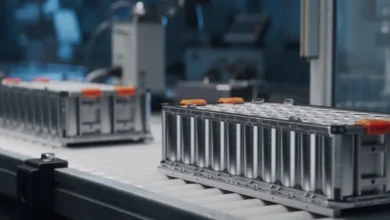
The station allows compatible electric heavy-duty trucks to replace depleted batteries with charged ones in less than five minutes, according to the company. It also includes public EV charging facilities for two-wheelers, four-wheelers and commercial vehicles.
The development extends BEM’s Mumbai–Pune Electric Freight Corridor, launched in October 2025. Located in Bhiwandi, a major warehousing and logistics hub in the Mumbai Metropolitan Region, the facility adds an energy-replenishment point to the infrastructure supporting electric freight operations.
The significance goes beyond the opening of a single station. For heavy-duty electric trucks, the commercial case depends not only on vehicle performance and energy costs but also on how quickly vehicles can return to work. Battery swapping offers one possible way to reduce charging-related downtime, provided the infrastructure, battery availability and operating model work reliably.
Blue Energy Motors–HPCL Station: Key Details
- Location: Bhiwandi, Maharashtra.
- Infrastructure: Battery swapping for compatible electric heavy-duty trucks.
- Reported battery-swapping time: Less than five minutes.
- Additional facility: Public EV charging for two-wheelers, four-wheelers and commercial vehicles.
- Partnership announced: January 2026.
- Mumbai–Pune Electric Freight Corridor launched: October 2025.
Why Battery Swapping Matters for Electric Freight
Heavy-duty freight operations are organised around vehicle utilisation, delivery schedules and turnaround times. A truck that spends a substantial part of its working day waiting for its battery to recharge may require changes to its route planning, shift structure or fleet size.
Battery swapping changes the energy-replenishment process. Instead of waiting for the battery installed in the truck to recharge, an operator can exchange it for a charged battery and resume operations. BEM says the process at its swapping station can be completed in under five minutes.
That time advantage could be valuable for freight operators running predictable routes and frequent trips. Faster energy replenishment may allow vehicles to spend more time transporting goods and less time waiting at charging facilities.
However, the reported swapping time should not be confused with the total operational turnaround time. Actual performance also depends on vehicle positioning, station access, battery availability, operational checks and any queues. The companies have not disclosed independent fleet-level data establishing how much additional utilisation the Bhiwandi facility delivers.
Battery swapping also requires compatible vehicle and battery systems, as well as sufficient inventory of charged batteries. The infrastructure provider must manage battery charging, storage, maintenance and replacement. These requirements influence the economics of the model alongside the speed of the physical swap.
Bhiwandi Adds to the Mumbai–Pune Freight Corridor
The location is an important part of the development. Bhiwandi is a major logistics and warehousing centre serving Mumbai and surrounding markets, making it relevant to freight movements that connect distribution facilities, industrial centres and consumption hubs.
BEM launched its Mumbai–Pune Electric Freight Corridor in October 2025 as part of its efforts to support electric heavy-duty trucking. The new station extends the energy infrastructure associated with that route and creates another point where compatible trucks can replenish their energy.
For electric freight corridors to become commercially useful, infrastructure needs to match actual vehicle movements. A station’s value depends on whether it is positioned where trucks need it, whether it can handle the required vehicle volumes and whether its operating hours align with freight schedules.
One operational station is therefore a starting point rather than proof of corridor-wide readiness. Wider adoption will require a network that provides dependable access to energy at relevant locations, with enough capacity to support the vehicles using the route.
The January 2026 partnership between BEM and HPCL provides a framework for developing this infrastructure at selected HPCL retail outlets. The latest commissioning demonstrates implementation of that collaboration, although the companies have not disclosed a confirmed rollout schedule or target number of additional heavy-truck swapping stations.
HPCL’s Retail Network Could Support Expansion
The partnership combines BEM’s electric heavy-duty truck business with HPCL’s established energy-retail network. This offers a potential route to developing infrastructure at locations already used by transport operators, rather than building an entirely separate network of sites.
The station’s public charging provision also broadens its role. In addition to supporting compatible electric trucks through battery swapping, it caters to electric two-wheelers, four-wheelers and commercial vehicles through conventional charging infrastructure.
The combined facility illustrates how an energy-retail site can accommodate different forms of electric mobility. Heavy-duty freight vehicles have distinct energy and operational requirements, while smaller EVs may use conventional charging. Providing both services at one location could broaden utilisation of the site.
However, the two systems should not be conflated. Public charging for other EV categories does not establish that the truck-swapping infrastructure can serve vehicles from other manufacturers. Battery swapping depends on vehicle and battery compatibility, and the announcement does not establish universal compatibility.
The wider opportunity for HPCL is to build additional services around its existing retail footprint as transport energy requirements evolve. Whether this becomes a scalable business will depend on infrastructure investment, demand, station utilisation and the economics of operating both charging and swapping services.
The Test Is Commercial Viability, Not Just Swap Speed
The Bhiwandi station addresses a practical requirement for electric freight, but the longer-term case for the model will depend on more than how quickly a battery can be exchanged.
Fleet operators need to evaluate the full cost of operating an electric truck, including vehicle acquisition, battery access, energy, maintenance, infrastructure availability and the cost of downtime. Battery swapping may improve utilisation, but those benefits need to be assessed against the cost of maintaining charged battery inventory and operating the network.
Battery ownership and payment arrangements also matter. Where swapping is offered through a service model, the division of responsibility for battery investment, maintenance and replacement can influence a fleet operator’s upfront costs and recurring expenses. The BEM–HPCL announcement does not disclose the commercial terms of the Bhiwandi facility.
The companies will also need to demonstrate that the model can operate reliably as more vehicles use the infrastructure. That means ensuring sufficient battery availability, predictable service and convenient station access along routes that support regular freight demand.
The immediate development is a useful step in building infrastructure for electric heavy-duty trucks. The more important milestone will be the expansion of a dependable network that supports daily commercial operations and makes the economics of electric freight work for fleet owners.
For India’s electric trucking ecosystem, the question is no longer only whether a truck can swap its battery in under five minutes. It is whether that speed, supported by a well-placed and reliable network, can translate into better vehicle utilisation and competitive freight costs. The performance of the Bhiwandi station—and the pace at which similar facilities follow—will help show whether this model can scale.
Sources: Blue Energy Motors’ announcement and official battery-swapping information; reporting by Autocar Professional and PTI/NDTV Profit dated 26 October 2026. Swapping time and company operating figures are attributed to the company. Analysis and interpretation are by Mobility Electrified.