JSW Greentech Wins First Order for 100 Electric Trucks

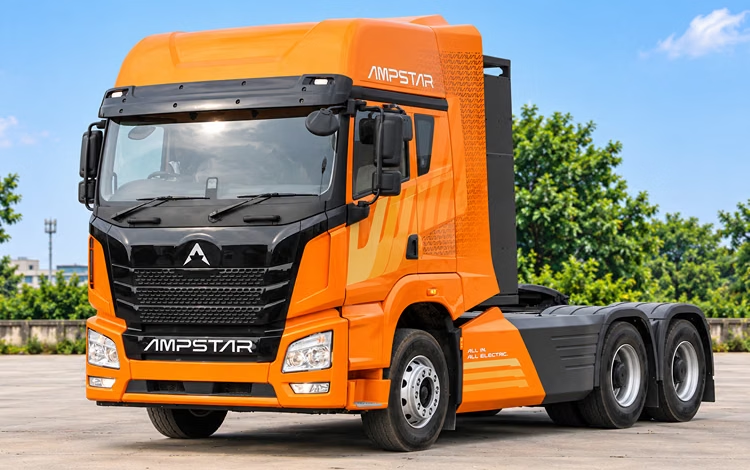
JSW Greentech’s first commercial order brings 100 heavy-duty electric trucks into its own industrial supply chain, with battery swapping and a dedicated logistics arrangement designed around the demands of cement freight.
JSW Greentech has secured its first commercial fleet order for 100 Ampstar 4×2 55-tonne electric tractor-trucks, which will transport clinker and slag for JSW Cement between Nandyal in Andhra Pradesh and Vijayanagar in Karnataka. The approximately 330-kilometre route will move an estimated 1.25 lakh tonnes of material each month, according to the companies’ announcement.
The deployment brings together three parts of the JSW ecosystem: JSW Greentech as the vehicle supplier, JSW Eco-Mobility as the Battery-as-a-Service (BaaS) provider, and Paradeep Parivahan as the logistics partner. Four dedicated battery-swapping stations are planned along the route to support fleet operations.
The significance is not simply that 100 electric trucks have been ordered. The project puts vehicle supply, battery access and industrial freight demand into a coordinated operating model. Its performance could offer a useful indication of how electric heavy-duty transport works on predictable, high-volume routes.
Fleet: 100 Ampstar 4×2 electric tractor-trucks
Vehicle class: 55-tonne gross vehicle weight category, as described by the company
Route: Nandyal, Andhra Pradesh, to Vijayanagar, Karnataka
Route length: Approximately 330 km
Material: Clinker and slag
Estimated cargo movement: 1.25 lakh tonnes per month
Battery model: Battery-as-a-Service through JSW Eco-Mobility
Planned infrastructure: Four dedicated battery-swapping stations
Why the First Order Matters for Ampstar
JSW Greentech launched its Ampstar commercial electric vehicle brand in September 2026, entering a market where vehicle performance is only one part of the purchase decision. Heavy-duty fleet operators also need predictable operating costs, dependable service support, financing options and infrastructure that fits their duty cycles.
The company’s first order targets an application within the JSW Group’s industrial operations rather than an open-ended, dispersed freight network. Cement and other bulk-material movements can offer a more defined starting point for electrification when routes, loading locations and cargo demand are relatively predictable.
That matters because electric heavy-duty trucks face a different set of constraints from electric passenger vehicles. Their economics depend on how much work they complete between energy stops, how long they remain unavailable for transport, the weight they carry and the reliability of their operating schedule. A vehicle that performs well in a demonstration still needs to deliver consistently across repeated commercial trips.
The Ampstar 4×2 tractor-truck is specified by JSW Greentech with peak power of 430 kW and peak torque of 2,600 Nm. Those figures provide an indication of the vehicle’s powertrain output, but they do not, on their own, establish its range under load, energy consumption per kilometre or cost competitiveness against diesel trucks.
Battery Swapping Becomes Part of the Freight Model
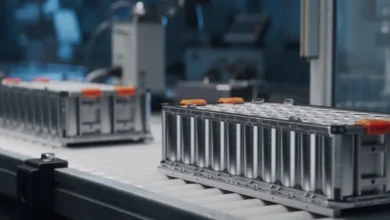
The planned four swapping stations are central to this deployment. Instead of relying solely on plugging a truck in and waiting for its battery to recharge, a swapping model allows a vehicle to exchange a depleted compatible battery for a charged one. If the process is reliable and the infrastructure is available when required, it can reduce the time a vehicle spends waiting for energy.
JSW Eco-Mobility will provide the batteries under a Battery-as-a-Service arrangement. This separates battery access from the truck’s vehicle purchase, potentially changing how fleet operators manage upfront capital expenditure and ongoing operating costs. The actual financial effect, however, will depend on the contract structure, service charges, battery availability and the responsibilities allocated to each party.
Battery swapping is not automatically more economical than depot charging. It requires compatible vehicle and battery systems, charged battery inventory, suitable handling equipment and careful coordination between stations and fleet schedules. Stations must also be located and sized to accommodate the flow of trucks without creating new bottlenecks.
For this project, the operational test will be whether four stations can support the required freight volume across the route while keeping vehicles productive. The announcement does not disclose station capacities, battery inventory, planned swap turnaround times or the precise commercial terms of the BaaS service. Those details will be important in assessing how the model performs at scale.
A Long-Term Logistics Contract Creates a Test Case
Paradeep Parivahan has separately announced a 10-year contract with the JSW Group to deploy and operate the 100 electric trucks. The long contract period provides a framework for testing the vehicles and operating model beyond a short pilot, although the financial terms have not been publicly disclosed.
The expected movement of 1.25 lakh tonnes of clinker and slag each month gives the project a measurable operating target. But tonnage alone will not show whether electrification is succeeding. The fleet’s performance will also depend on trips completed, payload utilisation, energy use, unplanned downtime, maintenance requirements and the ability to keep swapping infrastructure available.
These metrics matter to the customer as well as the logistics provider. JSW Cement needs materials moved reliably to support industrial operations. Paradeep Parivahan needs to fulfil its transport commitments and operate the fleet commercially. JSW Eco-Mobility must supply batteries and infrastructure that do not undermine vehicle availability. The model works only if these responsibilities align in practice.
That makes the deployment a useful test of an integrated industrial-freight model. The participating businesses have a common commercial interest in making the vehicles productive, but the arrangement still has to prove that it can deliver dependable transport at a competitive cost.
Manufacturing Capacity Is the Next Part of the Story
The 100 trucks are planned to be manufactured at JSW Greentech’s greenfield facility at Chhatrapati Sambhajinagar, Maharashtra. The proposed site covers approximately 90 acres and is designed for an annual capacity of 15,000 electric buses and trucks.
That planned capacity is much larger than the initial order, positioning the project as an early commercial application for Ampstar rather than a measure of the plant’s eventual output. The facility’s development and ramp-up will therefore be important to the company’s broader commercial vehicle ambitions.
Planned manufacturing capacity should not be confused with installed production capability or actual annual production. The plant is still under development, and the company has not established through this order alone how quickly production will scale or how much of its planned capacity will be utilised.
The first fleet gives JSW Greentech a defined application in which to build operating experience and gather real-world performance data. That experience could inform future deployments for other industrial customers, but expansion will depend on the results of this initial programme and the company’s ability to deliver vehicles, support and infrastructure reliably.
JSW Greentech’s first 100-truck order is therefore an important early milestone, not yet proof of a universally viable model for electric heavy-duty freight. The more revealing measures will emerge once the fleet is operating: vehicle utilisation, swapping-station reliability, cost per tonne moved and the actual reduction in diesel consumption and emissions.
The bigger question is whether an integrated vehicle, battery and logistics model can make electric trucks commercially dependable for industrial freight—not just technically capable of moving it.
Sources: JSW Group’s official Ampstar launch announcement; reporting by ETAuto and Autocar Professional on the 100-truck order and logistics contract. Details on station capacity, BaaS pricing, vehicle utilisation and independently verified emissions savings were not available in the sources reviewed.