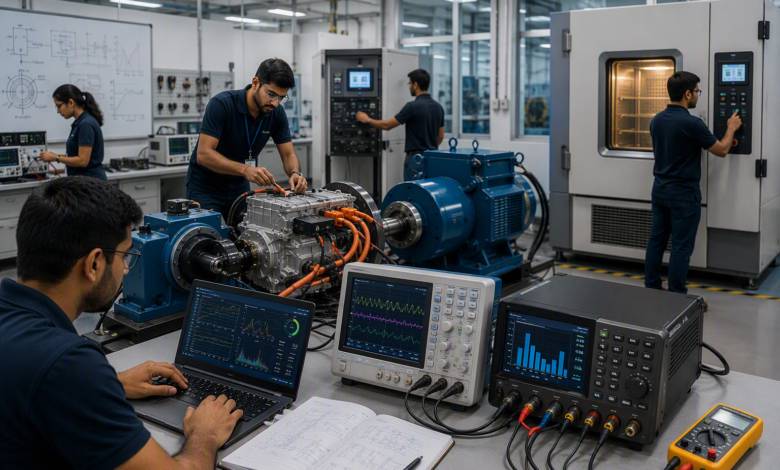
India’s EV story is entering a new phase, one where adoption alone will no longer define success. The real opportunity lies in building indigenous capabilities across powertrain design, engineering, validation, manufacturing and technology ownership. In this insightful article, Krishna Pratap Madathil, Head of R&D for E-Powertrain, Greaves Cotton Limited, explores how India can move beyond vehicle assembly to develop a globally competitive EV powertrain ecosystem, driven by innovation, collaboration and long-term engineering capability.
India’s electric mobility journey started more than two decades ago, with early efforts such as Reva showing that electric vehicles could be built and used in India. For many years, EVs remained a niche topic. That changed when policy support, technology improvements, and customer awareness started coming together. The National Electric Mobility Mission Plan in 2013 and the FAME schemes gave the industry an important push. Slowly, EVs moved from being a discussion point to becoming a serious part of the automotive market. Today, India is seeing electrification across two-wheelers, three-wheelers, passenger vehicles and commercial mobility applications. The adoption is especially visible in three-wheelers, where the business case is stronger as total cost of ownership matters due to high daily running. The first phase of India’s EV journey was about adoption. The next phase has to be about capability. India cannot measure success only by how many EVs are sold or assembled locally. The more important question is how much of the technology, engineering knowledge, intellectual property and validation capability is being built in India. If we want long-term competitiveness, we need to move from being a large EV market to becoming a serious EV technology base.
Assembly Is Necessary but Not Sufficient
The growth of the EV industry has allowed many companies to enter the market by assembling vehicles using imported motors, controllers, battery cells, semiconductor devices, software stacks, and design support. This approach has helped the market grow faster. It has also created jobs, supplier activity, and local value addition. But we should be clear about what this model gives us. Assembly helps in commercialisation, but sustainable competitiveness comes when companies own the product architecture, software, manufacturing processes and failure-learning cycle. In EVs, these areas decide efficiency, performance, reliability, safety and cost. If the critical technology remains outside the country, then local industry will remain dependent for design changes, cost optimisation, troubleshooting and future upgrades. This does not mean India should avoid partnerships or imported technology. Partnerships are useful, especially when they accelerate learning. But the objective should be clear. We should use partnerships to build internal capability, not to become permanently dependent.
The Powertrain Is the Heart of the EV
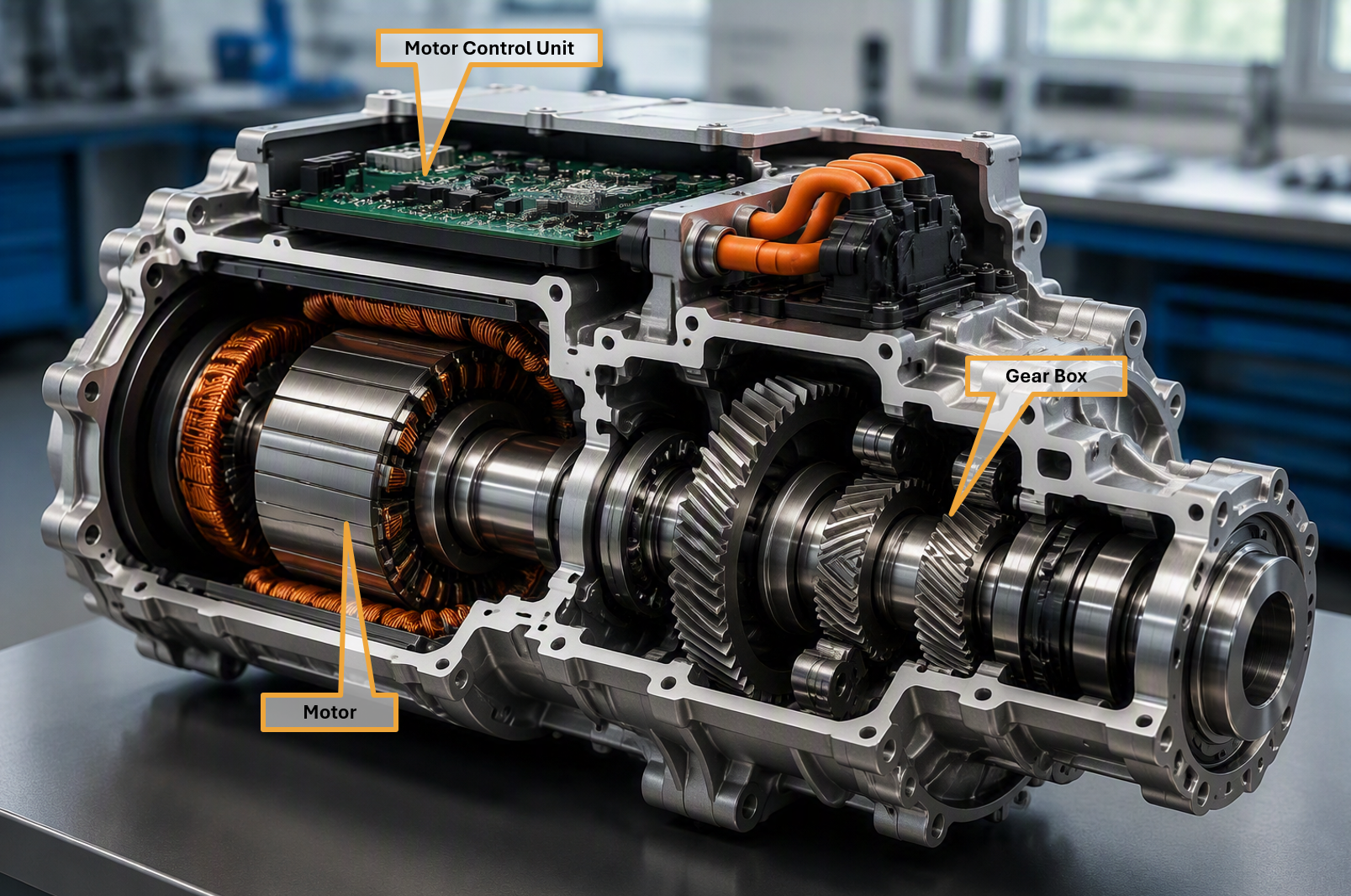
Batteries get most of the attention in EV discussions, and rightly so. They decide energy storage, range and a major part of vehicle cost. But the way an EV performs on the road is heavily influenced by its powertrain. The motor, inverter, embedded software, transmission, battery interface and vehicle control system together convert stored energy into useful vehicle motion. A good powertrain is not just a collection of parts. It is a system. Motor design affects efficiency and thermal performance. The inverter affects torque response, losses and reliability. Software decides how smoothly and safely the system behaves in real driving conditions. Transmission and gear ratio selection affect gradeability, top speed and energy consumption. Vehicle integration decides how all of this performs outside the laboratory. As the industry matures, we are also seeing higher integration of motors, inverters and transmissions into compact drive units. This can reduce weight and simplify vehicle architecture, but it also increases the demand for strong system engineering. The challenge is to balance cost, reliability, performance and manufacturability. This balance cannot be achieved by datasheet selection alone. It needs repeated design, testing, field feedback and continuous improvement.
The Real Challenge Is Capability Building
Building an indigenous EV powertrain capability is not only about localising parts. It is about developing the ability to define, design, validate, manufacture and improve the complete system. This is where the real difficulty lies. One major challenge is dependence on imported semiconductors and electronic components. Modern EV powertrains use microcontrollers, power devices, sensors, gate drivers and communication ICs. Supply chain resilience and technology security therefore become important. Another challenge is the material and process knowledge needed for motors. High-efficiency traction motors depend on magnetic materials, electrical steel, insulation systems, rotor construction, winding processes and thermal design. These are not areas where capability can be built only by buying equipment. Manufacturing is equally demanding. EV powertrains need precision, process control and consistency. Motor winding, high-voltage assembly, inverter manufacturing, sealing, insulation and end-of-line testing all need disciplined execution. Testing and validation also require maturity. Validation judgement has to be developed, knowing what to test, how to interpret failures and when a design is ready for the field comes only through experience. India has enough engineers. The gap is in engineers who have taken complex powertrain products from concept to production over multiple product generations. That learning cycle is critical. It teaches what the simulation did not show, what the supplier data did not capture and what the customer usage pattern actually does to the product.
Collaboration Can Accelerate the Journey
India will need a strong collaboration ecosystem involving industry, academia, startups, suppliers, testing agencies and policymakers to master every part of EV. Each of these groups brings a different strength. Academic institutions and research labs can contribute in electromagnetics, power electronics, materials, controls and simulation. Industry can bring real product problems, manufacturing experience, cost targets and customer expectations. The real challenge is to find the point where academic research priorities and industry commercialisation needs genuinely to meet. When this happens, research can move faster from the lab to usable products. Startups can also play an important role in embedded software, diagnostics, battery management, charging infrastructure, data platforms and digital technologies. Established companies bring scale, quality systems, vehicle integration knowledge and market access. The difficulty is that new technology is often adopted slowly, while large organisations remain focused on profitability and risk reduction. This gap needs to be managed with pilot programmes, clear validation gates and realistic business cases. Technology partnerships will remain important. But successful partnerships should go beyond product procurement. They should include joint development, localisation, engineering access, validation learning and capability building. The goal should be to absorb knowledge and build confidence to improve the product in India.
What India Should Target by 2035
The coming decade is an important window for India. By 2035, success should not be measured only by EV penetration. It should also be measured by India’s ability to design, develop, validate and manufacture world-class EV technologies within the country. A key target should be global competitiveness in traction motors, motor controllers and power electronics. Indian companies need deep capability in motor design, inverter hardware, embedded software, functional safety, thermal management, EMC, diagnostics and automotive-grade validation. These are the areas that decide whether products can compete outside India as well. Technology leadership must also be supported by manufacturing strength. Automated production, high-precision motor manufacturing, reliable electronics assembly, Industry 4.0 practices and strong quality systems will be necessary. Products should be designed not only for local use but also for export readiness and international customer expectations. Innovation must finally convert into intellectual property and commercialised platforms. Patents are useful, but they are only one measure. More important is whether companies can repeatedly create reliable products, improve them based on field data and use that knowledge across product families. India has the market, engineering talent, manufacturing base and entrepreneurial energy to become more than an EV adoption story. This will require patient investment in people, laboratories, design tools, validation culture, manufacturing processes and technology partnerships with the right intent. The next decade should be used to build confidence in our own engineering capability. India must continue to adopt EVs, but it must also learn to own the technologies that power them. That is when the country can move from participating in the EV transition to shaping it.
Note to Readers: The views expressed in this article are those of the author and are presented for informational purposes only. They do not necessarily represent the views of Mobility Electrified.