Solar Energy Is Reshaping the Way India Charges Its Electric Vehicles

As global EV adoption accelerates, the convergence of solar energy and clean transportation is evolving from complementary synergy into an essential imperative. Currently the majority of EVs are charged overnight by a fossil fuel-powered grid. With an increasing number of EVs plugging into the grid along with a rapidly growing array of household appliances/electronics, increasing reliance on the grid is straining its ability to reliably meet energy demand. As EV adoption accelerates, coupling charging infrastructure with solar generation creates zero-emission infrastructure, lowers the levelised cost of energy and minimises load on the grid during peak hours. With over 300 days of sun a year, India is naturally primed for solar-powered infrastructure. A 10 kW solar array can charge up to 4 to 5 EVs daily, and when paired with energy storage, ensure seamless operation even during outages or peak demand. However, at the heart of standard solar charging for electric vehicles exists a fundamental conversion challenge: solar panels generate direct current (DC), which a traditional inverter converts to alternating current (AC) for grid synchronisation or home distribution. When an EV is plugged into a standard AC charger, the vehicle’s internal on-board charger (OBC) must convert that AC power back into DC to store it in the traction battery. This multi-stage conversion process results in cumulative energy losses ranging from 10% to 20%, entirely dissipated as ambient heat.
Shift to Higher Efficiency: DC to DC eliminates intermediate conversion steps, and manufacturers are pioneering architecture built around direct DC to DC coupling and high-voltage DC microgrids.
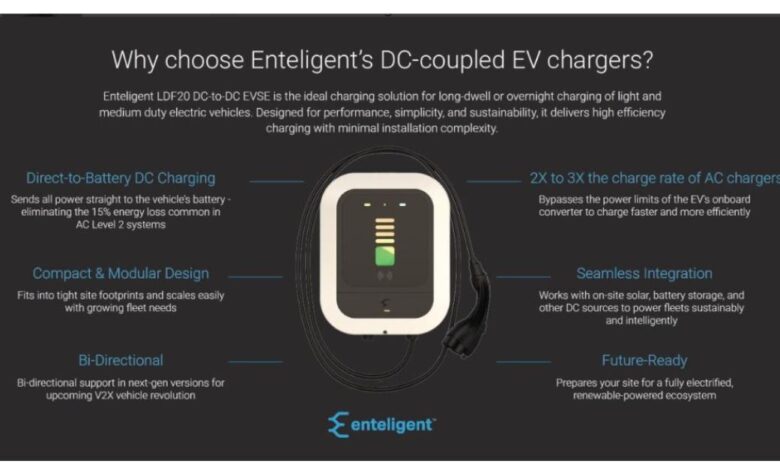
DC to DC coupling: California-based Enteligent has introduced commercial solar-powered DC to DC EV chargers that interface directly with the DC output of solar photovoltaic (PV) arrays. The solar EV charger can supply 25 kW of fast DC charging while also supporting vehicle-to-home (V2H) and vehicle-to-grid (V2G) home energy resilience. By bypassing the traditional inverter stage altogether, this architecture optimises overall system efficiency and accelerates charging speeds. Companies like CNTE (CATL subsidiary) along with Fujian Nebula Electronics are building massive charging stations in China linking PV arrays, BESS and DC chargers on a common DC bus. Solar panels and large stationary batteries feed a shared DC backbone, which provides power directly into electric vehicles.
Microgrids: While direct DC-to-DC setups are effective in distributed configurations, higher capacity charging hubs need to rely on hybrid, grid-tied infrastructure to bridge the gap between intermittent solar generation and peak vehicle demand. The Shell Recharge Hub, one of the largest fast charging hubs globally by volume, featuring hundreds of high-power charging points, utilises a massive rooftop solar array to supplement grid power, shave peak loads and stabilise local energy consumption. Transport operators across Germany and other parts of Europe are turning to solar-plus-storage DC microgrids to fuel municipal electric bus networks and commercial delivery fleets. Motorway operators in Europe (Poland & Croatia) are embedding photovoltaic canopies across key transit corridors. Industrial pilots have successfully operated high-speed DC fast chargers heavily insulated from local utility constraints by pairing direct solar generation with localised modular storage.
100% Off-Grid Deployment: Standalone solar plus storage solutions are critical for supporting zero-emission mobility in locations where traditional grid infrastructure is impractical, costly, or completely unavailable. India-based Axon Energies has developed a fully off-grid 250 kW DC-to-DC charger, where the system bypasses all AC/DC conversion, directly utilising DC power from solar PV arrays and battery energy storage systems (BESS). Beam Global, a US-headquartered firm, has developed a self-contained, transportable solar-powered charging unit featuring a sun-tracking array and integrated battery storage. Designed to fit within a single standard parking space, it requires zero trenching, heavy construction, or grid connection.
Mining Corridors: In mining corridors across Australia and Latin America, heavy commercial fleets and electric haul trucks rely on containerised solar storage microgrids. These containers help deliver uninterrupted high-capacity power directly to heavy-duty industrial vehicles.
Island Nations: Island nations in the Pacific and Caribbean are increasingly adopting transportable, off-grid solar charging architectures to power localised electric passenger and utility fleets, eliminating reliance on imported diesel generators and fragile local subsea cables.
Way Forward: While standard AC charging will remain the most cost-effective baseline for residential overnight charging, the continuous optimisation of DC-to-DC component costs is rapidly reshaping the economics of commercial energy delivery, with direct solar DC charging steadily transitioning from niche pilots into a practical, highly efficient cornerstone of the mainstream EV charging ecosystem.

Gurusharan Dhillon,
Director – e-Mobility,
Customized Energy Solutions
Note to Readers: The views expressed in this article are those of the author and are presented for informational purposes only. They do not necessarily represent the views of Mobility Electrified.