Intelligent Mobility – The Convergence of EV, SDV, AI and Connected Vehicles

The automotive industry is undergoing its most significant transformation since the invention of the Internal Combustion Engine (ICE). For over a century, vehicles were predominantly mechanical systems, until the introduction of electronics paved the way for digital innovation. Rapid advances in computing, communications, and software have now propelled the automotive industry into a digital revolution. The past decade has been defined by the rapid growth of electric vehicles (EVs), which have evolved from niche alternatives to mainstream mobility solutions. However, electrification is only the beginning.
The next phase of automotive evolution will be shaped by the convergence of four transformative technologies: electrification, artificial intelligence, software-defined vehicles and connected vehicles.
Together, these technologies are redefining the automobile from a mode of transport into an intelligent, connected, and continuously evolving mobility platform. This convergence is giving rise to Intelligent Mobility, a future in which vehicles can communicate, learn, adapt and optimise their performance in real time, delivering safer, more sustainable and highly personalised transportation experiences.
Electrification: The Digital Foundation
Electrification is far more than replacing the internal combustion engine with a battery and an electric motor, it transforms the automobile into a digitally controlled energy platform. Beyond delivering zero tailpipe emissions, EVs provide an architecture that seamlessly integrates advanced electronics, software, and intelligent control, making them the ideal foundation for the next generation of mobility.
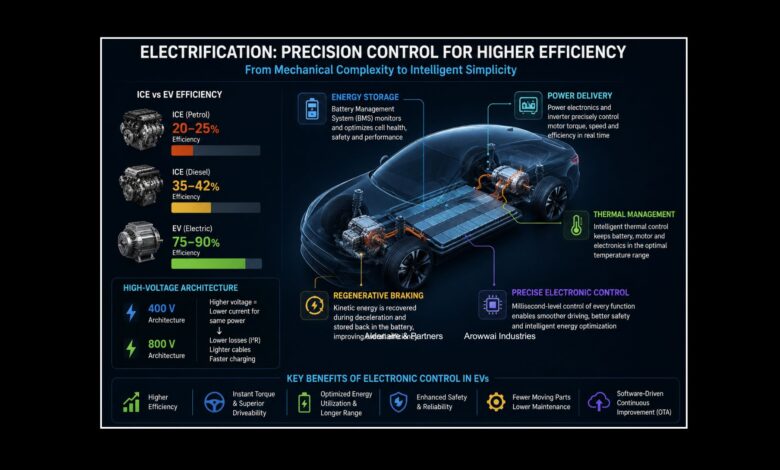
Compared to conventional ICE vehicles, EVs have a significantly simpler drivetrain with far fewer moving parts. Power electronics and software precisely manage energy storage, power delivery, braking, and thermal management. This results in exceptional energy efficiency, with EV powertrains typically achieving 75–90% efficiency, compared with 20–25% for petrol engines and 35–42% for diesel engines.
Modern EVs employ 400 V and increasingly 800 V, high-voltage electrical architectures. Higher operating voltages reduce electrical losses while enabling lighter wiring, higher efficiency and ultra-fast charging.
Unlike the mechanically constrained control systems of ICE vehicles, EVs offer millisecond-level electronic control of torque, braking and energy flow. This enables software-driven optimisation of vehicle performance, intelligent thermal management and regenerative braking, where kinetic energy is recovered during deceleration and returned to the battery, further enhancing efficiency and driving range.
Software-Defined Vehicles: The Digital Platforms
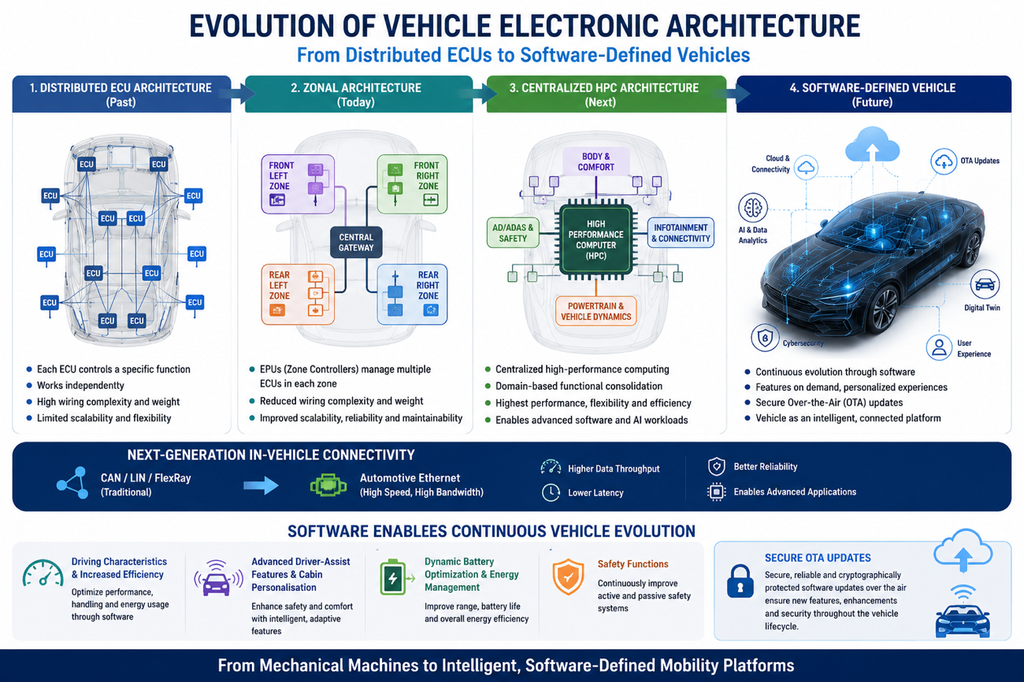
The rapid growth of vehicle electronics has fundamentally transformed automotive architecture. Early vehicles employed a distributed network of Electronic Control Units (ECUs), with each ECU dedicated to a specific function such as engine management, climate control or seatbelt monitoring. As vehicles incorporate hundreds of electronic functions, this architecture has become increasingly complex. To address this complexity, the industry is transitioning to zonal architectures, where high-performance EPUs manage multiple functions within a zone in the vehicle. The next evolutionary step is the centralised high-performance computing (HPC) architecture, which consolidates vehicle intelligence into a few powerful computing platforms. This shift is accompanied by the migration from traditional communication protocols such as CAN and LIN to high-bandwidth Automotive Ethernet, enabling faster data exchange and seamless software integration.
These advances are paving the way for SDVs, where software, not hardware, defines vehicle capabilities. Like smartphones, SDVs can continuously evolve through secure Over-the-Air (OTA) updates, enabling new features, enhanced cybersecurity, improved energy management, refined driving dynamics, advanced driver assistance, and personalised cabin experiences throughout the vehicle’s lifecycle. The result is a vehicle that becomes smarter, safer and more capable long after it leaves the factory.
Artificial Intelligence: The Intelligence Layer
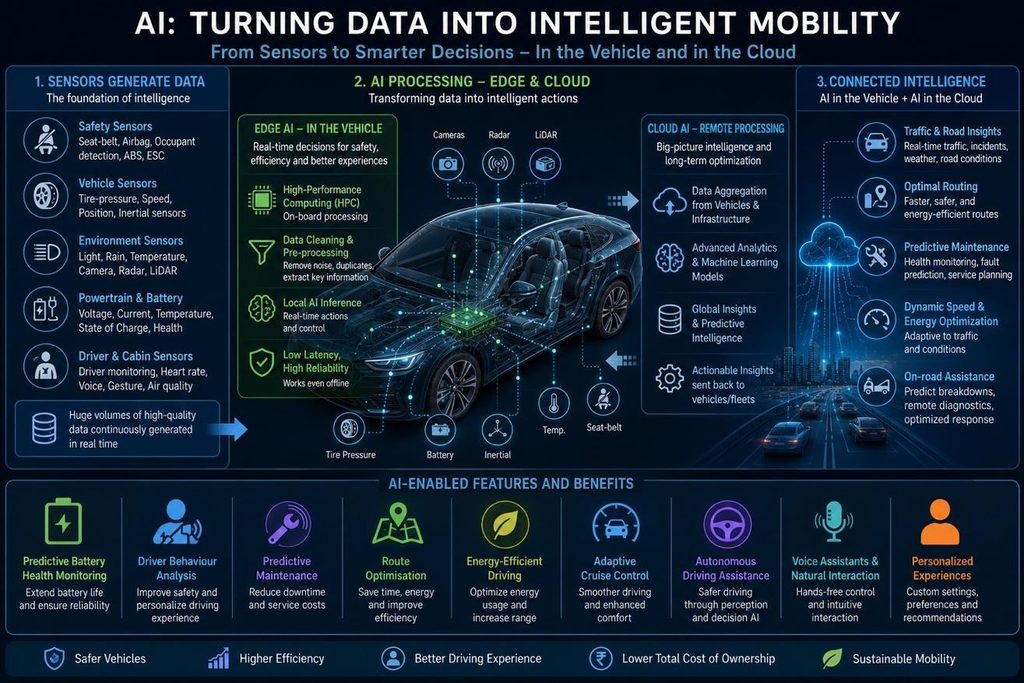
Advances in sensors and sensor networks have enabled cyber-physical systems and the Industry 4.0 paradigm, where the digital and physical worlds interact seamlessly. The automotive industry has embraced this transformation, integrating a wide range of low-cost, high-performance sensors that continuously monitor vehicle health, driver behaviour and the surrounding environment. From seatbelt and tyre-pressure monitoring to adaptive lighting and advanced driver-assistance systems, these sensors generate vast amounts of real-time data.
AI is the intelligence layer that converts this data into informed decisions and autonomous actions. With the emergence of HPC platforms within SDV, AI processing is increasingly moving to the vehicle itself (edge AI), enabling real-time applications such as predictive battery health, energy optimisation, adaptive cruise control, driver monitoring, predictive maintenance and personalised in-cabin experiences. At the same time, cloud-based AI analyses fleet-wide and traffic data to optimise routing, improve road safety, predict maintenance requirements and enhance mobility services. Together, edge AI and cloud AI are transforming vehicles into intelligent systems that continuously learn, adapt, and deliver safer, more efficient and highly personalised mobility.
Connected Vehicles: Extending Collective Intelligence
A vehicle’s onboard intelligence is inherently limited by its computing resources and locally available data. However, when connected to the broader mobility ecosystem, its ability to learn, adapt, and make informed decisions expands dramatically. This concept, known as Vehicle-to-Everything (V2X), enables seamless communication between vehicles, cloud platforms, infrastructure, the power grid, pedestrians and other road users. Continuous data exchange provides real-time situational awareness and collective intelligence. V2X enables applications such as smart charging, Vehicle-to-Grid (V2G) energy exchange, traffic optimisation, fleet management, remote diagnostics and digital mobility services.
By combining insights from connected ecosystems with edge and cloud AI, vehicles evolve into collaborative, intelligent mobility platforms that are safer, more efficient, and continuously improving.
The Power of Convergence
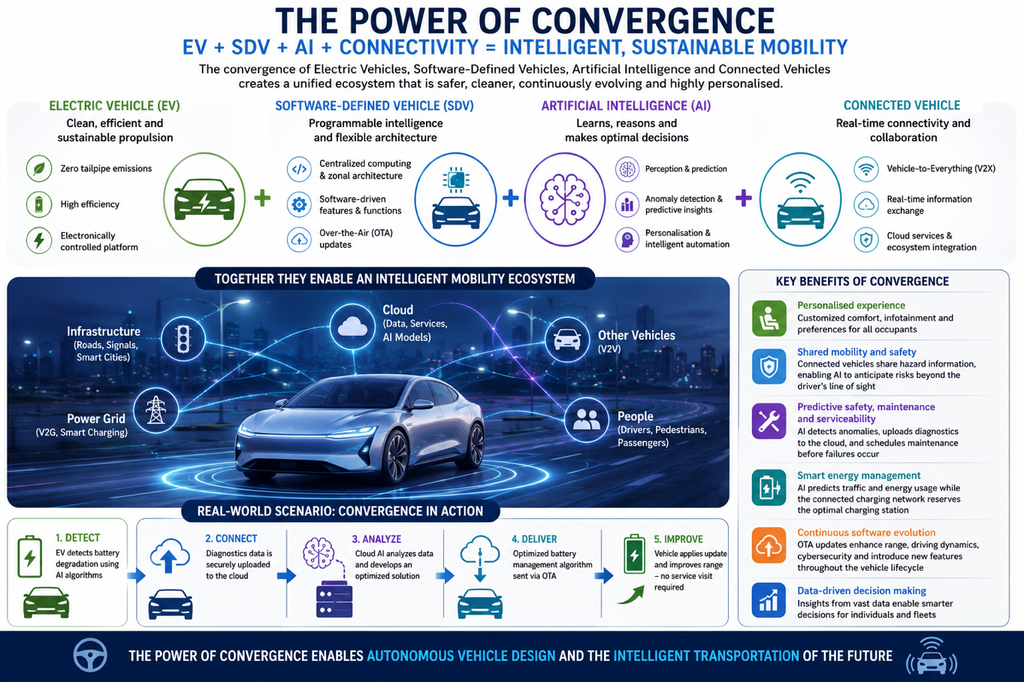
The convergence of EVs, SDVs, AI and Connected Vehicles is creating a new paradigm of Intelligent Mobility one that is safer, cleaner, continuously evolving and capable of delivering highly personalised and efficient transportation. While each technology is transformative in its own right, their true potential lies in their integration. Together, they combine sustainable propulsion, software-driven innovation, intelligent decision-making, and real-time connectivity into a unified mobility ecosystem.
In this ecosystem, the EV provides a clean, electronically controlled platform; the SDV delivers a flexible, software-centric architecture; AI transforms data into intelligent decisions; and connectivity enables seamless collaboration between vehicles, infrastructure, cloud services, and the power grid. This convergence powers personalised in-cabin experiences, predictive safety and maintenance, intelligent energy management, collaborative traffic optimisation, and continuous feature enhancement through secure OTA updates.
For example, AI can detect battery degradation, upload diagnostics to the cloud, receive an optimised battery management algorithm through an OTA update, and improve driving range without a service visit. Such capabilities demonstrate how these four technologies work together to create tangible value for users. Ultimately, this convergence forms the technological foundation for autonomous driving and the intelligent transportation systems of the future.
Challenges on the Road to Intelligent Mobility
The transition to intelligent mobility brings immense opportunities but also significant challenges. Unlike traditional vehicles, which largely operated as isolated systems, software-defined and connected vehicles interact continuously with the external world, expanding the potential attack surface. Consequently, cybersecurity, functional safety, secure OTA updates, and robust authentication become fundamental requirements for protecting vehicle integrity and occupant safety.
Equally important are data privacy and governance, as connected vehicles continuously exchange operational and personal data with cloud platforms and digital services. The growing reliance on AI also raises concerns around transparency, accountability, and the explainability of automated decisions, particularly in safety-critical applications.
These are engineering challenges requiring robust solutions. The convergence of EVs, SDVs, AI and connectivity is fundamentally reshaping how vehicles are designed, operated, and experienced. The automobile is evolving into an intelligent platform that continuously learns, adapts, and collaborates. Ultimately, the future of mobility will be defined not by any single technology, but by their seamless integration into an intelligent, secure and sustainable ecosystem, where progress is measured not only in kilometres per charge, but in intelligence per journey.

Dr. Anand Lakshmanan,
Senior Project Advisor,
Center of Excellence for Advanced Automotive Research (CAAR)
Note to Readers: The views expressed in this article are those of the author and are presented for informational purposes only. They do not necessarily represent the views of Mobility Electrified.