India’s EV Charging Networks: From Availability to Intelligence

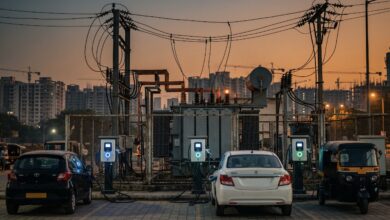
Ten years ago, EV charging in India was mostly an act of faith, a handful of chargers scattered about to prove electric mobility could work at all. That argument is over. In 2025 alone, Indians bought more than 2.3 million electric vehicles, and charging has moved from a talking point to a genuine bottleneck. The public network has grown quickly: from roughly 5,000 chargers in 2022 to close to 29,000 by early 2026. Impressive on paper, until you set it against the fleet it has to serve. India still runs at about one public charger for every 235 EVs. The Netherlands manages one for every five, and even the widely used global benchmark sits between 6 and 20. We are not short of ambition or policy; PM E-DRIVE alone has earmarked funds for tens of thousands of new chargers. We are short of chargers that are close enough, fast enough, and this is the part we underrate, actually working when a driver pulls in.
Building more chargers is necessary. Making sure each one runs reliably is what will decide whether drivers ever trust the network. Those are two different problems, and the second one is only now getting the attention it deserves.
Beyond installation: the operational problem
The first decade was about deployment more chargers, more locations, less range anxiety. That job isn’t finished, and it only gets harder as adoption climbs. But a second problem arrives with scale: running what you’ve built.
Once an operator has thousands of charging points spread across a dozen cities, the hard question stops being “where do we install the next one?” and becomes “which ones are down right now, and why?” A charger no one can rely on is worse than no charger at all; it sends one driver away frustrated and warns the next ten to avoid the spot.
This is where software has quietly become as important as the hardware. Remote monitoring, live diagnostics, predictive maintenance and over-the-air updates are what let an operator catch a failing unit before a customer does. Uptime, not raw charger count, is what separates a good operator from a bad one. In case of many public charging networks, more than half of charge points are non-functional, a blunt reminder of how wide the gap between “installed” and “usable” can get.
No two sites behave the same
A highway fast-charging stop, an office basement, a residential society and a 24-hour fleet depot have almost nothing in common in how they’re used. The highway stop sees short, intense bursts. The office fills up at 9 a.m. and sits idle by noon. The depot runs all night.
There is no single model that fits all of them, and pretending otherwise wastes money. Good software lets one operator manage very different sites from a single screen reading each site’s rhythm and adjusting to it, rather than forcing every location into the same template.
Using the power you already have
Here is a constraint that bites harder the more we scale: many good charging locations simply don’t have the electrical capacity to run every charger at full power at once. Upgrading a transformer or raising a sanctioned load is slow and expensive, often a year of paperwork and several lakh rupees.
Dynamic load management is the practical answer. Instead of hard-wiring, say, 30 kW to each of ten bays, which would demand 300 kW, a site rarely has the system watches live demand and moves power to where it’s needed. Take that corporate office: ten cars plug in at 9 a.m., three need to leave by eleven, and the rest sit until evening. The system pushes power to the cars in a hurry, then reallocates it as they unplug. A single 150 kW connection ends up doing work you’d otherwise have to size at 300. That’s not a nice-to-have; it is frequently the difference between opening a site this quarter and waiting a year for a grid upgrade.
Charging becomes ordinary infrastructure
Malls, offices, housing societies, highways, and logistics parks all of them are turning into charging destinations, and drivers will stop treating charging as an event. Finding a free point, starting a session, watching it charge and paying should feel as routine as tapping a card at a toll booth or booking a cab. When it doesn’t, people notice and they remember which network let them down.
The grid is the next frontier
The load is about to get heavier. As buses and commercial fleets electrify, vehicles with far bigger batteries and punishing duty cycles the strain on high-power charging and on the grid rises sharply. China, which has built roughly two-thirds of the world’s public chargers, is already wrestling with exactly this. Norway, where nearly nine in ten new cars are now electric, leans heavily on home charging to take pressure off its public network. India will have to do both at once and do it while integrating solar, battery storage and smarter grid coordination. That means real interoperability and common standards chargers, vehicles and the grid actually talking to each other, instead of sitting as islands.
What the next decade turns on
India’s next phase needs a great many more chargers; no argument there. But sheer count was the story of the last decade. The next one will be decided by how well those chargers run, whether the network is reliable, efficient and genuinely there when a driver needs it.
Build fast, yes. But build a network people can trust. In the electrified decade ahead, it is that trust, not the headline installation number, that will carry electric mobility across the line.

Anshuman Divyanshu,
CEO – EVSE,
Exicom