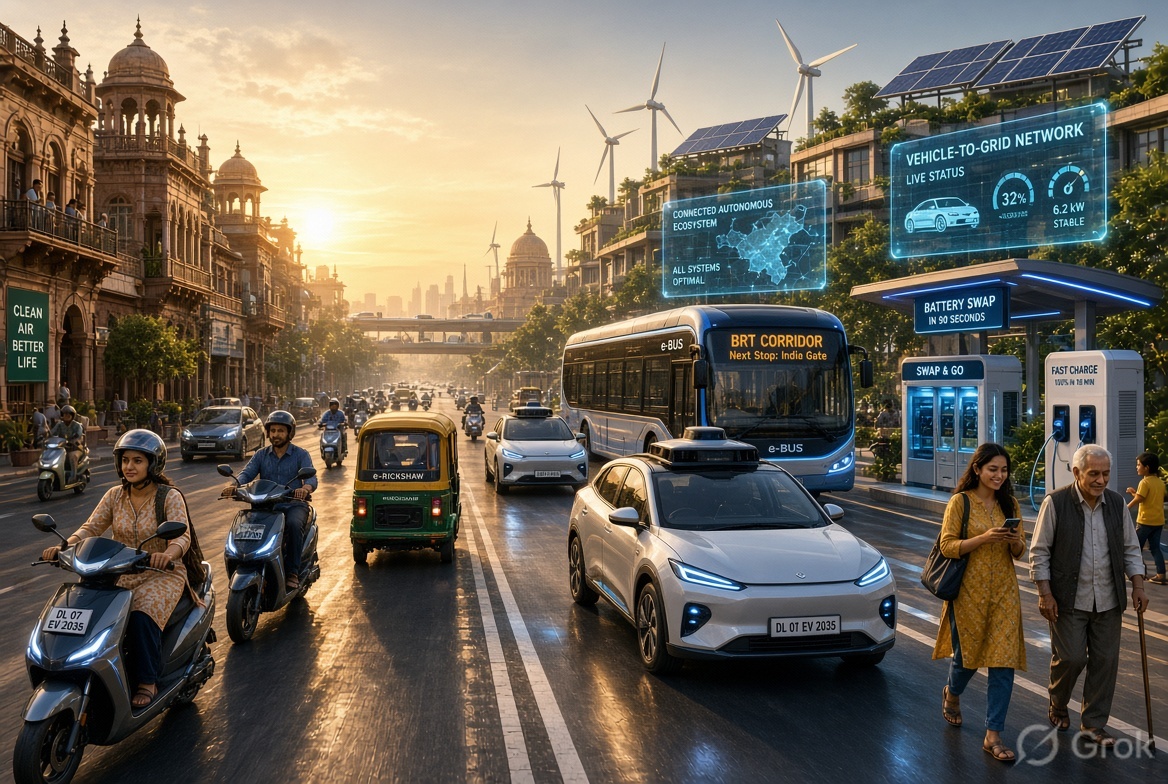
There is a particular sound that defines Indian streets: the layered hum of two-stroke engines, the honk-heavy choreography of auto-rickshaws and the diesel growl of city buses lurching between stops. For over a century, that sound has been the soundtrack of Indian mobility. But somewhere between the last decade’s policy experiments and this decade’s industrial build-out, the soundtrack has begun to change. In its place: the near-silent whirr of an electric scooter pulling away from a traffic signal, the soft charge-port click of an EV plugged in outside a Bengaluru apartment and the whisper of an electric bus gliding through Ahmedabad’s BRT corridor. India is not merely adopting electric vehicles. It is attempting something more audacious: building an entirely new mobility architecture, from the mine to the motor, from the charger to the grid, in real time, while the vehicles are already on the road. This is the story of that architecture: where it stands today, what it must become by 2035 and why the next ten years will determine whether India’s electrified ambitions become the world’s most consequential mobility transition or a cautionary tale of promise outpacing execution.

The defining transformation of the next decade will not simply be the shift from internal combustion engines to electric vehicles; it will be the convergence of clean energy, intelligent mobility, and digital infrastructure into a single, integrated ecosystem. By 2035, mobility will be autonomous, connected, zero-emission, and deeply intertwined with smart grids, renewable energy, green hydrogen, advanced batteries, AI, and circular manufacturing. To realize this vision, industry must act decisively today by accelerating indigenous innovation, strengthening resilient supply chains, investing in future-ready infrastructure, and fostering bold public-private partnerships. The global leaders of 2035 will be those who build the entire mobility ecosystem, not just the vehicles.
— Dr. Ranjith Krishna Pai, PhD, FRSC, Scientist ‘F’ / Senior Director, Climate, Energy and Sustainable Technology (CEST)
Chapter One: The Numbers Behind the Noise
Start with the scoreboard, because it tells a story of genuine, if uneven, momentum. India crossed roughly 2.45 million electric vehicle sales in FY2025–26, a jump of close to a quarter over the previous year, pushing EV penetration in overall automobile sales to around 8.3 per cent. Every one of the four major vehicle categories two-wheelers, three-wheelers, passenger cars and commercial vehicles recorded double-digit growth. Electric two-wheelers alone crossed the six-figure monthly sales mark ten times in a single fiscal year, something that happened only four times the year before. Look closer and the texture becomes more interesting. Electric three-wheelers, the humble e-rickshaws and cargo autos that move people and parcels through the last mile of nearly every Indian city, have quietly become one of the most electrified vehicle categories on Indian roads, with adoption rates far outpacing passenger cars. Electric commercial vehicles, though tiny in absolute volume, more than doubled year-on-year, as logistics operators discovered that fleet electrification pencils out faster than personal car ownership does. And electric passenger vehicles, while still a rounding error against India’s overall car market, touched an all-time high of over 176,000 units in 2025, a 77 per cent jump, with mass-market SUVs doing the heavy lifting rather than luxury badges.

India’s electrified decade will be driven less by passenger cars and more by two-wheelers and three-wheelers leading mass adoption. Electric 2W penetration crossed 9% in June 2026, while electric 3W penetration has already exceeded 55%, indicating that three-wheelers have crossed the tipping point and two-wheelers are emerging as the next major growth segment. The biggest transformation ahead will be localising India’s battery value chain. India imported over $2 billion worth of lithium-ion cells in FY24, making domestic cell manufacturing critical under the ₹18,100 crore ACC PLI scheme. Three priorities will shape this transition: securing lithium, cobalt and nickel through overseas assets and recycling; standardising charging and battery-swapping infrastructure; and reskilling the workforce for specialised EV technologies. By 2035, EVs could potentially approach the government’s 30% target of total vehicle sales, provided these foundations are strengthened.
— Preetesh Singh, Principal, NRI Group
This is the paradox at the heart of India’s mobility transition: it is being built from the bottom up. Not from gleaming electric sedans in showrooms, but from the delivery rider’s scooter, the fleet operator’s cargo three-wheeler, and the municipal corporation’s electric bus. It is a transition led by economics, not aspiration: drivers and small business owners doing the fuel-cost arithmetic and concluding that electric simply costs less to run, even before any environmental consideration enters the picture. That is precisely why the 2035 story matters. India’s electrification curve did not start with luxury early adopters chasing status, the way it did in parts of Europe and North America. It started with cost-conscious, high-utilisation vehicles. That foundation, utilitarian, unglamorous and relentlessly practical may be the single most important reason to believe India’s transition can scale rather than stall.
Chapter Two: The Architecture of Ambition
Every industrial transition needs a blueprint and India’s electrification effort rests on a stack of overlapping government programmes, each addressing a different layer of the puzzle. Demand-side incentives began with FAME (Faster Adoption and Manufacturing of Hybrid and Electric Vehicles), which in its various iterations has subsidised everything from electric two-wheelers to city buses. Its successor schemes, including PM E-DRIVE, have shifted focus toward commercial and public transport electrification, recognising that buses and fleet vehicles offer the fastest emissions and fuel-import savings per rupee spent. Complementing these, the government slashed the Goods and Services Tax on electric vehicles from 12 percent to 5 percent and on EV chargers from 18 percent to 5 percent, a tax structure that makes the total cost of EV ownership meaningfully more competitive against petrol and diesel alternatives.
Supply-side manufacturing incentives centre on the Production-Linked Incentive or PLI, framework separate schemes for auto components and for advanced battery cells. The goal is unambiguous: stop importing the guts of the electric vehicle and start building them domestically, from battery cells to motors to power electronics. The stated national target is striking in its scope: roughly 30 percent of private car sales, 70 percent of commercial vehicles, 40 percent of buses and 80 per cent of two- and three-wheelers running on electricity by 2030, translating to something in the neighbourhood of 80 million electric vehicles on Indian roads within this decade, with the 2035 horizon envisioning electrification as the default rather than the exception across most vehicle categories.
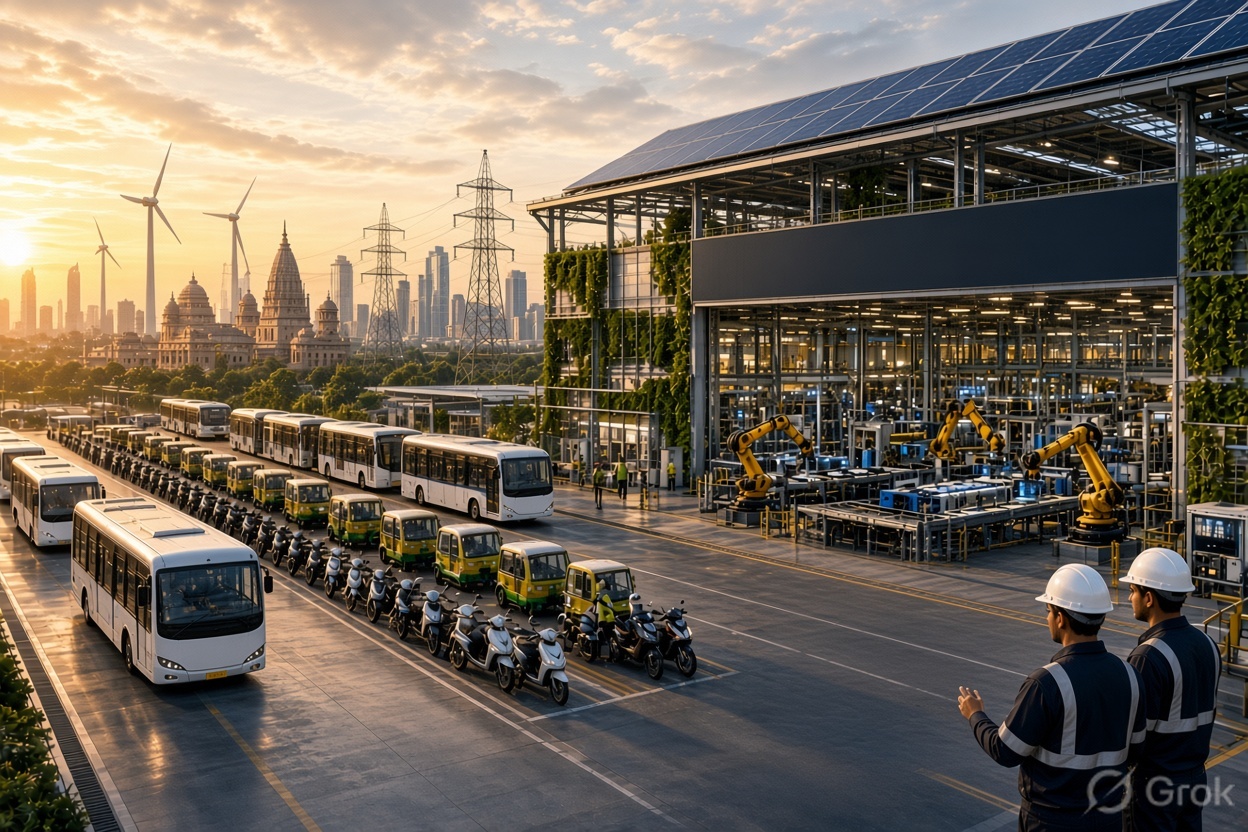

The future belongs to mobility that is electric, intelligent, connected and above all, human-centric. The biggest transformation in India’s mobility ecosystem over the next decade will be the shift from manufacturing vehicles to building intelligent, software-defined and energy-connected mobility systems. Electrification, AI, automation, digital manufacturing, and energy storage will converge to create smarter, more sustainable mobility. To make this vision a reality by 2035, the industry must invest today in advanced manufacturing capabilities, resilient local supply chains, skilled talent, and collaborative innovation between OEMs, technology providers, startups, and academia. India’s opportunity is not just to adopt the future of mobility but to lead it globally. By 2035, success won’t be defined by how many vehicles we electrify but by how effectively we use technology to improve human lives. That is the future of truly human-centric mobility.
— Himanshu Jadhav, Director & CEO, Jendamark India Pvt Ltd
Critical minerals and cell manufacturing form the most consequential and most difficult layer of the stack. This is where India’s ambitions currently collide hardest with industrial reality, and it deserves an honest accounting. The Advanced Chemistry Cell PLI scheme, launched in 2021 with an outlay of roughly ₹18,100 crore, aimed to build 50 gigawatt-hours of domestic battery cell manufacturing capacity by 2025. As of late 2025, only about 2.8 per cent of that target, roughly 1.4 GWh, had actually been commissioned, and that entirely by a single company, Ola Electric, at its Krishnagiri gigafactory in Tamil Nadu. Investment levels reached only a quarter of what was targeted. Job creation reached barely a tenth of the projections. Visa delays for the Chinese technical specialists needed to install cell-manufacturing equipment, punishing two-year installation timelines, and steep domestic value-addition requirements have all slowed the buildout considerably.
This is not a story to gloss over in a cover feature about electrified ambition; it is the story’s central tension. India has announced more than 100 GWh, by some counts closer to 178 GWh, of battery manufacturing capacity across various proposed projects from companies including Tata’s Agratas, Reliance New Energy, Amara Raja, and Exide. Tata’s Agratas gigafactory at Sanand in Gujarat, a 40 GWh facility on a 320-acre site, is one of India’s largest single clean-energy industrial investments, with commercial cell production targeted for 2026–27. Reliance has announced a 40 GWh facility with plans to scale toward 100 GWh. But announced capacity and commissioned capacity remain two very different numbers, and as of today, India still imports nearly all of its lithium-ion cells, overwhelmingly from China.
The honest read: India is roughly five to ten years away from a genuinely competitive domestic cell manufacturing base, assuming policy execution improves from here. That is not a reason for pessimism about 2035; it is a reason to be precise about which parts of the electrified mobility stack are already working (vehicle assembly, two- and three-wheeler manufacturing, motor and power-electronics production) and which parts still require sustained, unglamorous industrial follow-through (cell chemistry, cathode materials, critical mineral refining).
Chapter Three: The Charging Question
No electrified mobility vision survives contact with a driver who cannot find a place to plug in. India’s public charging network has expanded at a genuinely rapid clip: public charging stations grew from a low base to roughly 29,000 by the end of 2025, at a compound annual growth rate approaching 78 percent over recent years. Karnataka, powered by early and aggressive state policy, has emerged as the leading state for public charging infrastructure, narrowly ahead of Maharashtra. Yet the ambition on the table dwarfs even that impressive growth rate. Industry estimates suggest India needs something on the order of 1.3 million charging stations by 2030 to support the vehicle parc it is targeting, which implies installing roughly 400,000 new charging points every single year between now and then. Against that yardstick, 29,000 stations nationwide looks less like an achievement and more like a down payment.
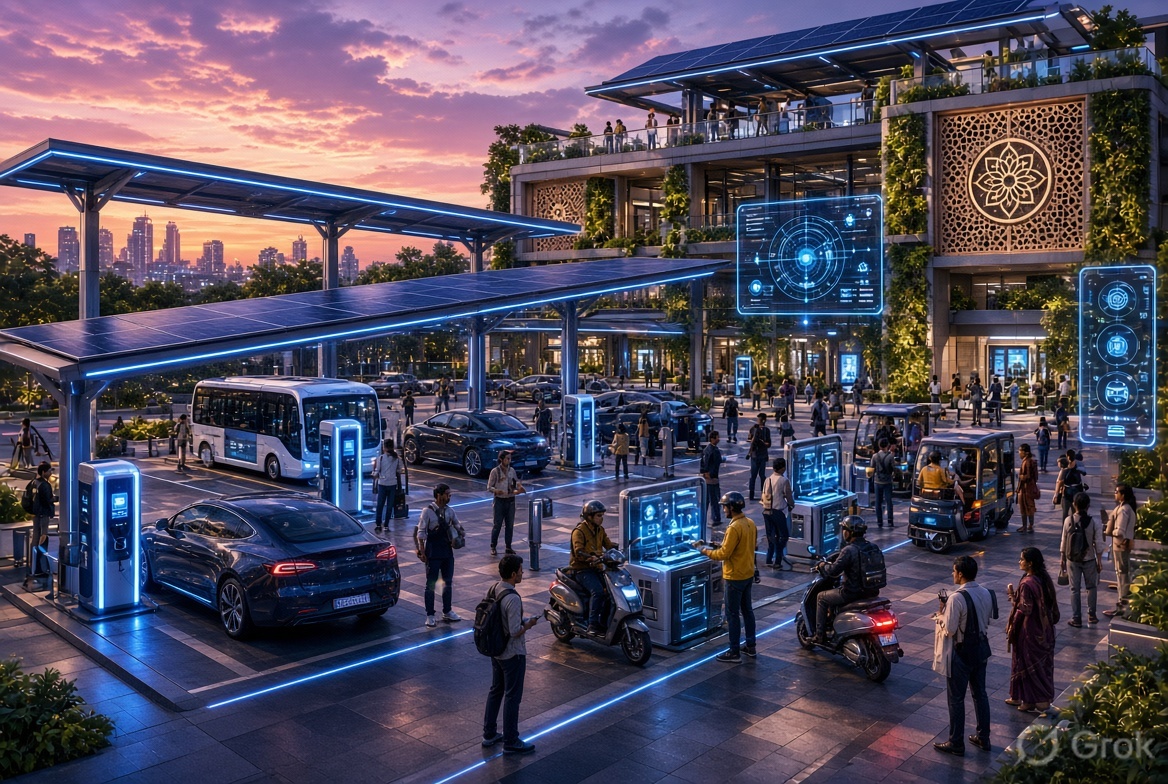

The single biggest transformation India will witness over the next decade will be the rapid expansion of charging and alternative energy infrastructure across Tier I, II and III cities, making clean mobility accessible to every corner of the country. This will accelerate the adoption of passenger electric three-wheelers, electric trucks and other commercial EVs that are already proving their economic viability through a strong total cost of ownership model. As global conflicts continue to impact energy markets, India must reduce its dependence on imported oil and focus on electricity, hydrogen and other alternate fuels. Achieving energy independence is not just an environmental goal. It is an economic imperative that will strengthen India’s growth, resilience and long-term competitiveness.
— Dr. Uday Narang, Founder & Chairman, Omega Seiki Mobility
The charging story for 2035, then, is really three separate stories layered on top of one another. The first is urban home and workplace charging: the invisible, unglamorous infrastructure of apartment building wiring, housing society approvals, and workplace parking retrofits that will carry the bulk of two-wheeler and passenger car charging, much as it does in every mature EV market globally. The second is public fast-charging corridors along national highways, essential for the small but growing segment of long-distance electric car and bus travel, and for easing the range anxiety that remains the single most cited barrier to EV adoption among prospective four-wheeler buyers. The third, and in many ways the most India-specific, is battery swapping: an infrastructure model tailored to the country’s enormous fleet of electric two- and three-wheelers, where a depleted battery pack can be exchanged for a charged one in the time it takes to fill a fuel tank, sidestepping charging-time constraints entirely for commercial riders who cannot afford downtime.

The public acceptance of EV over ICE would be higher. Range anxiety would be lower, as there would be multiple options charge (fast & slow)/swap coexisting. This would also bring down life of batteries anxiety. There would be superior cells/batteries & eAxle. The cost of ePowertrain would have further come down due to demand & due to progress in cell chemistry research for higher availability, safety, efficiency & performance. Local cell manufacturing would be productive. The cell recycling would be a norm (circular economy). The way forward between ICE, EV, Hydrogen, Hybrid would be clearer. An era of stability for EV.
— Muralidhar MK, CTO – Chief Technology Officer, SUN Mobility Pvt Ltd
By 2035, the most plausible outcome is not a single dominant charging paradigm but a layered mesh of all three, differentiated by vehicle class, use case, and geography: dense swap networks in gig-economy-heavy urban cores, fast-charging corridors threading the golden quadrilateral highway network, and slow overnight charging quietly built into the electrical backbone of new residential and commercial construction.
Chapter Four: Who Is Building This
Behind every statistic sits a company placing a bet, and the competitive map of India’s electrified mobility sector has reshuffled dramatically even over the past eighteen months. In electric passenger cars, Tata Motors has held the pole position for years, though its dominance has narrowed sharply; its market share slid from around 73 percent in 2023 to roughly 40 percent in 2025, a sign of a maturing, increasingly contested market rather than weakness. Mahindra has emerged as the most consequential challenger, with its born-electric BE 6 and XEV 9e models, built on the dedicated INGLO platform, pulling meaningful volume away from Tata’s early lead, and its new XEV 9S, a three-row mass-market electric SUV, pushing feature sets typically reserved for pricier vehicles down into the mainstream. Hyundai entered the fray with an electric version of its best-selling Creta SUV, lifting its EV market share from a negligible 1 per cent to 4 per cent within a year. Global entrants BYD, VinFast, and Suzuki with its e-VITARA are each testing different strategies for cracking a famously price-sensitive market, from aggressive localisation to battery-rental models that lower upfront ownership costs.
In electric two-wheelers, the story of the past year has been one of dramatic reordering. TVS Motor, Bajaj Auto, and Ather Energy now occupy the top three positions by volume. Hero MotoCorp, starting from a near-negligible EV share, posted the fastest growth of any major player, its electric sales share climbing from under half a per cent to nearly 4 per cent of its monthly volumes within a single year. Perhaps most tellingly, Ola Electric, for several years the two-wheeler EV market’s undisputed leader, saw its annual sales fall by roughly half, slipping to fourth place behind legacy manufacturers who moved slower initially but arrived with deeper distribution networks, established service infrastructure, and greater consumer trust once they committed to electrification in earnest. It is a pointed reminder that in a market this size, first-mover advantage is worth less than execution and trust built over decades. In electric three-wheelers, arguably the segment doing the most real economic work in Indian cities every day, legacy players Mahindra Last Mile Mobility, Bajaj Auto and TVS lead a fragmented market of hundreds of competitors, while in electric commercial goods carriers, Tata Motors again leads, trailed by specialist players like Euler Motors.

The three-wheeler segment is leading India’s EV transition, and Mahindra Last Mile Mobility is proud to be at the forefront of electrifying the last mile. With over 40% of the category already electrified, we are confident that the entire three-wheeler ecosystem will go electric by 2030. To accelerate this transition, we must continue strengthening local manufacturing, expanding reliable service networks, and delivering customer-centric products.
— Suman Mishra, Managing Director and CEO, Mahindra Last Mile Mobility Limited
In electric buses, a category central to public transport decarbonisation, companies including JBM Electric Vehicles, Switch Mobility, PMI Electro Mobility and Olectra Greentech are competing for state transport corporation contracts that will define how Indian cities move their populations for the next two decades.

By 2035, India’s mobility ecosystem will evolve beyond vehicle electrification into an integrated, intelligent energy and mobility network. EVs will function as connected assets supported by widespread charging infrastructure, renewable energy integration, and digital platforms. Rather than facing fragmented standards, India is poised to become a global standard-bearer in the EV landscape through strong public-private collaboration. Achieving Net Zero will require practical innovation, long-term planning, and deep stakeholder partnerships tailored to local needs. To realise this vision, the industry must accelerate investments in charging networks, interoperable solutions, domestic manufacturing, skilled talent development, and policy stability.
— Manoj Gupta, CEO, Ecofuel EV Charging Technologies, JBM Group
What unites nearly every one of these companies is a bet on India as a manufacturing base, not just a sales market. Tata’s joint venture with Jaguar Land Rover opened a new electric vehicle plant in Tamil Nadu in early 2026, built in agreement to the first vehicle in under eighteen months and designed to run entirely on renewable power. VinFast has committed to a multi-billion-dollar integrated manufacturing facility, also in Tamil Nadu. Hyundai is executing a large-scale expansion of its Chennai operations to localise EV platforms. Tamil Nadu, Gujarat, and Telangana have each positioned themselves as anchor states in this new industrial geography: Tamil Nadu for vehicle assembly and two-wheeler manufacturing; Gujarat for battery gigafactories and port-linked lithium imports; and Telangana for large-format battery manufacturing.

I believe India is entering a decade of mass electric vehicle adoption across every major mobility segment. The country’s mobility transformation is being driven by electrification and strengthened by the rapid development of a connected, intelligent and future-ready ecosystem supported by charging infrastructure, clean energy, digital technologies and advanced manufacturing. With electric vehicle penetration in city public transport expected to exceed 50 per cent by 2035, and public transport serving over 40 crore passenger journeys every day, the opportunity is unprecedented. Realising this vision calls for accelerated investments in domestic battery cell manufacturing, charging infrastructure, renewable energy integration, circular economy practices and smart mobility solutions. By 2035, India’s EV ecosystem is expected to be valued at over USD 200 billion, creating significant opportunities across manufacturing, technology, infrastructure and services. The leaders of tomorrow will be those who make sustainable mobility accessible, affordable and dependable at scale, creating lasting economic, environmental and social value for the nation.
— Mahesh Babu, Managing Director, Olectra
Chapter Five: The Grid Beneath the Wheels
An electric vehicle is only as clean as the electricity that charges it, and this is where India’s mobility transition intersects with its far larger energy transition. The country installed a record amount of renewable capacity in the past fiscal year, with solar and wind additions both hitting new highs, and the government’s broader climate commitments envision a substantially decarbonised grid well before 2035. This matters enormously for the honesty of India’s electrified mobility story. A nation that electrifies its vehicle fleet while continuing to lean heavily on coal-fired power has simply relocated its emissions from the tailpipe to the smokestack: a real improvement in urban air quality, but a more modest one in overall carbon terms. India’s advantage is that its renewable buildout and its EV buildout are happening on roughly the same timeline, which means that by 2035, a much larger share of the electricity flowing into Indian EV batteries should be coming from solar and wind than is the case today. The two transitions are, in effect, racing each other toward the same finish line, and the extent to which they arrive together will determine how much genuine climate benefit India’s mobility shift ultimately delivers.

The single biggest transformation in mobility by 2035 will be the convergence of electrification, digital intelligence, and energy ecosystems, enabling vehicles to become active participants in a clean and connected energy network. To realize this vision, the industry must accelerate investments in scalable battery technologies, R&D, charging infrastructure, sustainability, circularity, and cross-sector collaboration. Success will depend not only on technological innovation but also on creating an integrated ecosystem that delivers affordability, sustainability, and energy resilience at scale, making electrified mobility accessible to all.
— Dr. Satya Dubey, PhD-CSci, Head of Global Battery Systems (R&D), Battery Sustainability and Mobility, VOLVO Group
There is a second-order grid question too: what happens to electricity demand when tens of millions of vehicles start drawing power, often in concentrated evening charging windows as commuters plug in after work? Smart charging, time-of-day tariffs and eventually vehicle-to-grid technology, where parked EV batteries feed power back into the grid during peak demand, will likely move from pilot projects to necessary infrastructure well before 2035, particularly in dense urban distribution networks that are already operating close to capacity.

The biggest change in mobility over the next decade will be witnessing EVs becoming much more than just a means of transport. EVs will increasingly act as intelligent energy assets by storing, sharing, and managing energy while supporting a cleaner, sustainable, and more resilient power grid. With Vehicle-to-Grid (V2G) technology, millions of EVs could collectively function as a Distributed Energy Network, helping balance renewable energy intermittency and enhancing grid reliability. AI will play a critical role by optimising charging patterns, improving battery life, predicting energy demand, predictive-to-prescriptive maintenance, and enabling smarter mobility services. To make this vision a reality by 2035, we must invest today in charging infrastructure, interoperable V2G standards, digital energy platforms, and strong collaboration among automakers, utilities, technology companies, academia, and policymakers. The future of mobility is not just electric, it is connected, intelligent, and deeply integrated with the energy ecosystem.
— Dr. Ramesh Singh, Senior Principal Manager, Energy Domain, ID Tata Elxsi; Senior Member, IEEE USA
Chapter Six: What Could Go Wrong
A credible vision for 2035 has to reckon honestly with its own failure modes, and India’s has several worth naming plainly. The cell manufacturing gap is the biggest one. If domestic battery cell production continues to lag as far behind schedule as it has to date, India’s electrified vehicle fleet will remain structurally dependent on Chinese cell imports well into the 2030s: a vulnerability that cuts against the entire strategic logic of electrification as a route to energy security and reduced import dependence. Closing this gap requires not just more PLI money but a functioning ecosystem of cathode materials, separators, electrolytes, and refined critical minerals that India currently lacks almost entirely.
Charging infrastructure could become the binding constraint on passenger car adoption, even as two- and three-wheelers continue to electrify on the strength of economics alone. Four-wheeler buyers, unlike two-wheeler riders, tend to make longer, less predictable trips, and range anxiety remains a persistent barrier cited by prospective car buyers. Closing the gap between 29,000 and 1.3 million charging points is not simply a matter of capital; it requires land, grid capacity, standardised protocols, and coordination across dozens of state electricity boards and municipal authorities.

The single biggest transformation by 2035 will be the conversion of mobility from a collection of vehicles into an intelligent and grid-connected energy system. An electric vehicle will no longer simply consume electricity. It will store it, exchange data, support the grid and retain value through second life and recycling. India must act today on four fronts. It needs world-class safety and interoperability standards, duty cycle-led charging infrastructure, chemistry-agnostic domestic manufacturing and transparent battery health data. Build these foundations now, and electrification becomes an affordability, energy security and industrial revolution.
— Randheer Singh, CEO, ForeSee Advisors and Former Director, NITI Aayog
Affordability remains a live question. India’s EV market has grown fastest precisely in the segments where the economics already work without heavy subsidy: high-utilisation two- and three-wheelers. Passenger cars, where upfront costs remain a genuine barrier for the median Indian car buyer, will need continued cost declines in batteries and components to reach true mass-market pricing parity with petrol equivalents, rather than counting on subsidies that may not remain politically durable for the entire decade.
Global competitive pressure is intensifying, not easing. Chinese battery and vehicle manufacturers, benefiting from over a decade of scale and a mature domestic supply chain, are likely to keep exerting pricing pressure on Indian manufacturers even as India’s own capacity comes online, meaning cost competitiveness, not just capacity, will determine whether Indian-made cells and vehicles can compete on price, not merely on domestic-preference policy. None of these are reasons to doubt that India’s mobility landscape in 2035 will look dramatically more electric than it does today. They are reasons to expect the path there to be uneven, sector-specific, and dependent on sustained execution rather than announcement momentum.
Chapter Seven: The Shape of 2035
Draw the line forward from where the data sits today, and a reasonably grounded picture of India’s roads in 2035 begins to emerge: not a utopian leap, but a plausible extrapolation of trends already visibly underway. Two- and three-wheelers will very likely be substantially electric by default. With adoption rates already climbing toward double-digit percentages of new sales and accelerating, and with the underlying economics of lower running costs per kilometre only improving as battery prices continue their long-term decline, this is the segment where India’s 2030 targets of 80 per cent electrification look genuinely achievable, and where 2035 could plausibly see electric variants as the default choice for most new two-wheeler and three-wheeler buyers rather than a niche alternative.
Commercial and last-mile logistics fleets will lead four-wheeler electrification, because fleet operators optimise ruthlessly for total cost of ownership across large numbers of vehicles, and electric already wins that calculation on high-utilisation urban routes. Expect delivery fleets, ride-hailing services, and municipal bus corporations to electrify well ahead of private car ownership. Private passenger car electrification will be real but partial, likely landing meaningfully below the 30 per cent target set for 2030, absent significant new interventions on affordability and charging density, though continuing to grow steadily as more manufacturers launch competitively priced electric models across body styles and price points, and as charging infrastructure fills in along the routes that matter most to private buyers.
Domestic battery and component manufacturing will have matured considerably, though probably not to full self-sufficiency. A realistic 2035 likely sees India producing a substantial share of its own cells, especially for two- and three-wheeler applications where energy density requirements are less demanding, while still importing a meaningful portion of higher-performance cells for passenger cars and commercial vehicles. A genuinely competitive, fully integrated domestic supply chain, from mineral processing through finished cell, will remain a stretch goal even by the middle of the next decade.
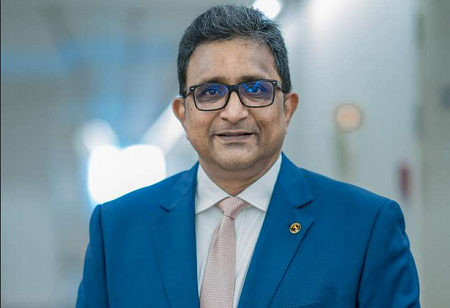
The biggest transformation in India’s mobility landscape over the next decade will be the shift from vehicle electrification to intelligent electrification, where software-defined vehicles, advanced safety systems, connected technologies, and battery intelligence work together as an integrated mobility ecosystem. To make this vision a reality by 2035, the industry must invest now in local R&D, scalable electronics, software capabilities and strong partnerships across OEMs, suppliers, and policymakers. We believe India has the opportunity not only to accelerate EV adoption but also to become a global innovation hub for safe, intelligent, and sustainable mobility.
— Prashanth Doreswamy, CEO & President, AUMOVIO India
The grid will be greener, and the two transitions of energy and mobility will be visibly converging, with a much larger share of vehicle charging drawing on renewable generation than is the case today, smart charging and time-of-day tariffs becoming standard rather than experimental, and the earliest vehicle-to-grid pilots moving toward wider deployment in select cities.

India’s Electrified Decade will be defined not just by EV adoption, but by the rise of an integrated, intelligent, and sustainable mobility ecosystem. Electric vehicles are only the beginning. By 2035, clean energy, AI-driven transport, autonomous and shared mobility, connected infrastructure, and Mobility-as-a-Service will reshape how India moves, shifting the focus from ownership to seamless, personalised, low-carbon mobility. To get there, we must accelerate charging and renewable infrastructure, invest in battery and digital innovation, strengthen policy collaboration, and expand shared and multimodal transport. With the right momentum, India can lead the world in smart, inclusive mobility.
— Srinivas Rao Ganta, Country Manager and Managing Director, Bender
Epilogue: The Decade That Decides
What makes this moment genuinely historic is not any single statistic: not the 24 lakh vehicles sold last fiscal year, not the 29,000 charging stations, not the 40 GWh gigafactory rising in Gujarat. It is the fact that all of these numbers are still small relative to where they need to be, and yet the direction of travel across manufacturing, policy, capital, and consumer behaviour has become genuinely difficult to reverse. Companies that were sceptical of electrification five years ago are now racing to catch up. States that watched from the sidelines are now competing aggressively for gigafactory investment. Consumers who once worried about resale value and range are increasingly making the switch simply because the economics have started to make sense.
India’s electrified mobility story will not be won by any single spectacular announcement: not a mega-factory groundbreaking, not a government target revision, not a splashy new model launch. It will be won or lost in the accumulation of unglamorous follow-through: whether cell manufacturing timelines get met rather than repeatedly extended, whether charging infrastructure keeps pace with vehicle sales rather than trailing behind them, whether the grid greens fast enough to make the electrons flowing into batteries genuinely clean, and whether affordability keeps improving fast enough to pull ordinary car buyers, not just fleet operators and early adopters, into the electric fold. The next ten years will not simply add electric vehicles to India’s roads. They will determine whether India builds a mobility system that is cleaner, more energy-secure, and more industrially self-reliant than the one it inherited, or whether the electrified decade remains, a decade from now, still mostly a story of ambition outrunning infrastructure.
Either way, the direction is set. The next ten years of mobility begin now.
Note to Readers: The views expressed in this cover story are those of the authors and quoted contributors and are presented for informational purposes only. They do not necessarily represent the views of Mobility Electrified.